
As an eCommerce company, you might have heard about MOQ and may have even implemented it at some level on your online store.
Usually set by manufacturers or wholesalers, MOQs can help you increase bulk sales and have better control over your inventory management.
For eCommerce stores, MOQs can often be a double-edged sword.
While they help balance production efficiency and unit costs, MOQs can also fulfil orders without tying up too much cash in stock.
With this in mind, let us start by understanding what MOQ is, its types, and the benefits and challenges you should be aware of.
Minimum Order Quantity: Definition, Examples & Overview
It is not just customers who pay for orders; online stores incur several types of costs, like labour, logistics management, and fixed setup, to ensure a transaction is successful, too.
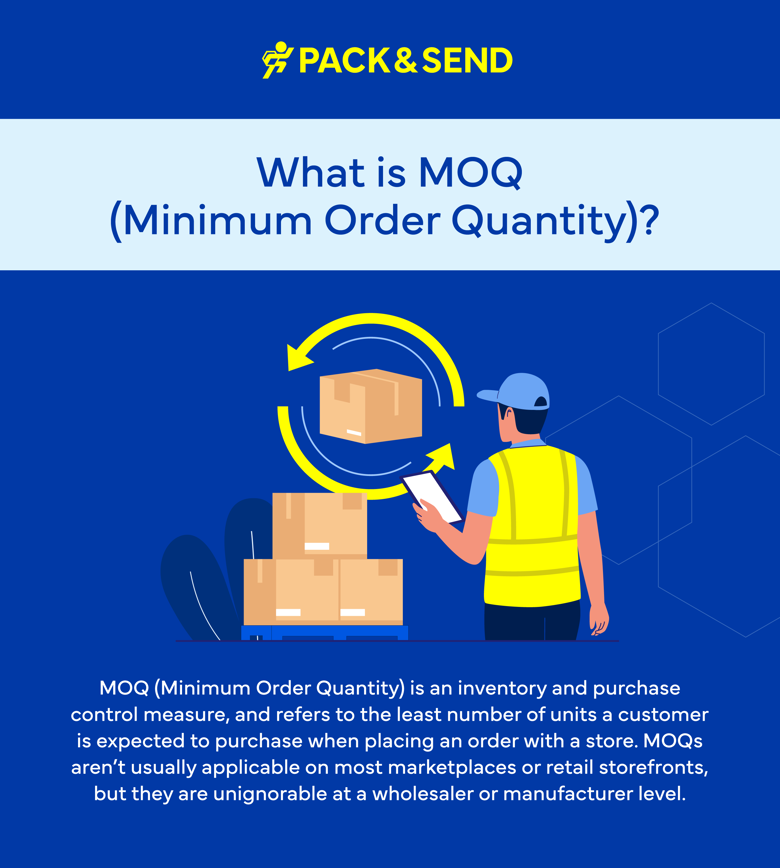
MOQ (Minimum Order Quantity) is an inventory and purchase control measure, and refers to the least number of units a customer is expected to purchase when placing an order with a store. MOQs aren’t usually applicable on most marketplaces or retail storefronts, but they are unignorable at a wholesaler or manufacturer level.
Depending on the product, such sellers may not be able to justify the cost of fulfilling a single transaction or just a few units.
MOQs are especially important to consider if you are an eCommerce manufacturer selling to wholesalers, or an online wholesaler selling to a retailer. For example, a nut-and-bolt manufacturer may set the MOQ as 5000 units for wholesalers and apply a bulk rate for the order.
On the other hand, certain manufacturers might set the MOQ based on the price bracket instead of units. For instance, a toy manufacturer might set the retail price of a teddy bear at $20, but might set the MOQ as $5000 for toy stores and retailers.
In some cases, your suppliers or manufacturers are flexible and may be open to changing the MOQ.
4 Primary Types of MOQ
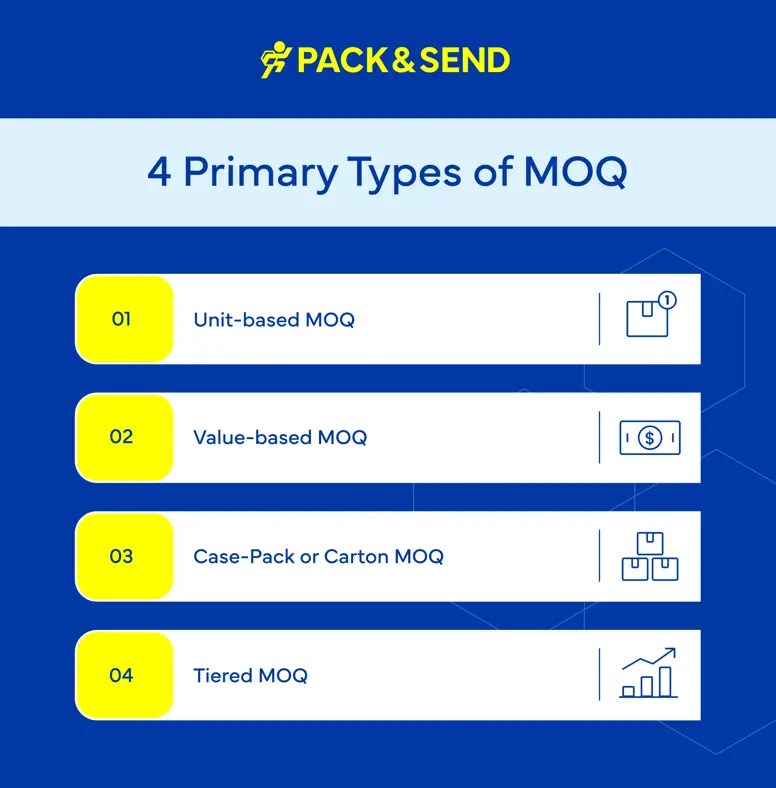
Now that we know what MOQ is and have a basic overview of it, here are four primary types that you should know about:
1. Unit-based MOQ
This type of MOQ model entails defining the minimum number of pieces, such as “200 units per order”.
Unit-based MOQ is the most common model followed for non-custom and standard SKUs, wherein production changeovers are fairly simple.
2. Value-based MOQ
MOQ in a value-based model is tied to the order value, offering more SKU flexibility provided the monetary floor is fulfilled.
This is the usual MOQ model followed by wholesalers and distributors who want to maintain profitability in orders, even if they let buyers mix the SKUs.
3. Case-Pack or Carton MOQ
MOQ is defined based on the quantity encompassed in a case or carton.
Commonly observed in marketplaces or wholesaler websites, to reduce picking and packing complexity and support pallet optimisation.
For example, if you are buying a jar of jam from a wholesaler, you might be required to buy 6 jars, as a typical carton might contain 6 jars.
4. Tiered MOQ
eCommerce companies and online retailers might define a higher price per unit till a certain unit threshold and offer competitive prices beyond that limit to motivate buyers to purchase more units.
For instance, a pen might cost $5 individually, but if you buy at least 100, the supplier might offer the pen at $2 per unit.
The tiered MOQ model is usually preferred for wholesaler-retailer transactions and helps retailers offset the holding costs.
4 Key Reasons for Implementing MOQ
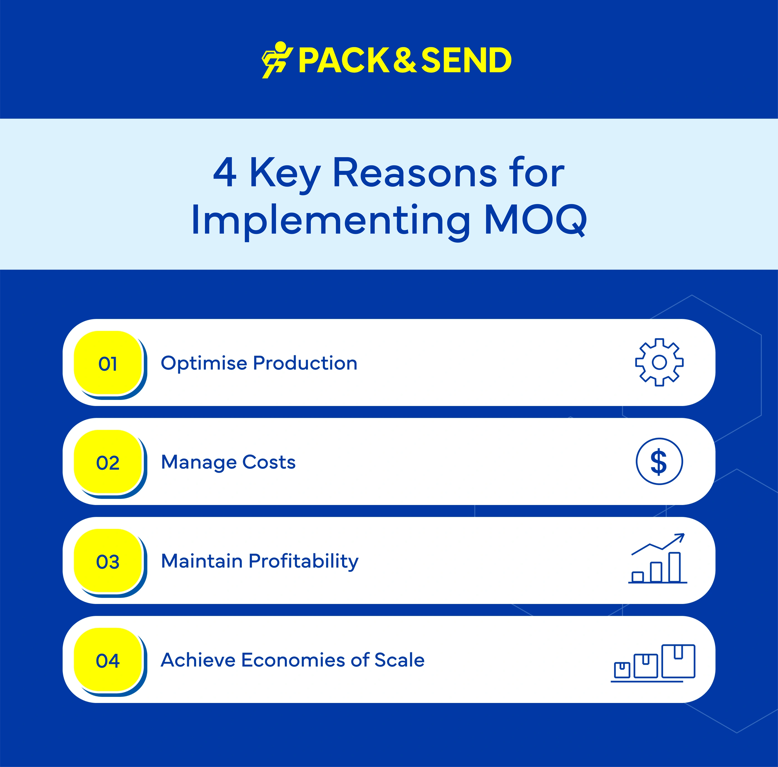
Ecommerce sellers who want to turn consistent profits would introduce or revise their MOQ strategies to level up their sales performance. At the very least, eCommerce companies can leverage the following benefits by implementing MOQ:
1. Optimise Production
If you produce the products that you are selling on your online store, you must define minimum batch sizes to reduce changeovers, waste, and idle time in the process. Following this approach will make your production lines more efficient.
If you are dealing with custom SKUs, setting high MOQs is required because manufacturers have to set up machinery, artwork, or tooling for small runs.
In 2026, manufacturers must deal with price volatility in energy, raw material fluctuations, and labour constraints to predict per-unit production costs.
This is especially pivotal if you operate in the apparel, packaging, or electronics sector, where production can involve frequent design updates and shorter life cycles, impacting your profitability.
2. Manage Costs
The inventory carrying costs associated with products usually include capital, insurance, storage, and shrinkage. Setting MOQs that align with your demand and turnover can help you define the amount of capital you want to actually tie up in slow-moving inventory.
For your suppliers and wholesalers, MOQs are set to ensure that each order covers fulfillment, fixed administration, and logistics costs, so that they don’t dilute margins on small and unprofitable orders. On the other hand, your online store can benefit from setting internal MOQs that avoid any low-quantity purchases that can elevate the freight costs.
3. Maintain Profitability
Setting MOQs is a proven way to protect your gross margins by helping you generate minimum revenue per production or fulfillment cycle.
MOQs can also help you offer better volume pricing without compromising profitability, hence empowering tiered pricing structures that embed these quantities.
For eCommerce stores, MOQs can help eliminate the operations and support bandwidth required to fulfil small and unprofitable micro-orders.
4. Achieve Economies of Scale
You can reduce the unit costs associated with manufacturing, materials, and freight by producing, purchasing, and shipping large quantities.
Implement pallet-based MOQs to leverage full-truck-load (FTL) or full-container-load (FCL) rates and bring down your costs, rather than relying on premium less-than-truckload (LTL) rates.
Economies of scale can translate into true savings only if you sell all your inventory before your markdowns and carrying costs can erode your profit margins. By setting an optimal MOQ, you can balance the per-unit cost reductions with the real risks and high stock holding costs.
How to Calculate Minimum Order Quantity (MOQ)?
Every eCommerce business has a unique way of setting MOQ, as it must be tailored to the business's requirements. Let us start by understanding the factors that impact the minimum order quantity of your product.
Factors Affecting MOQ
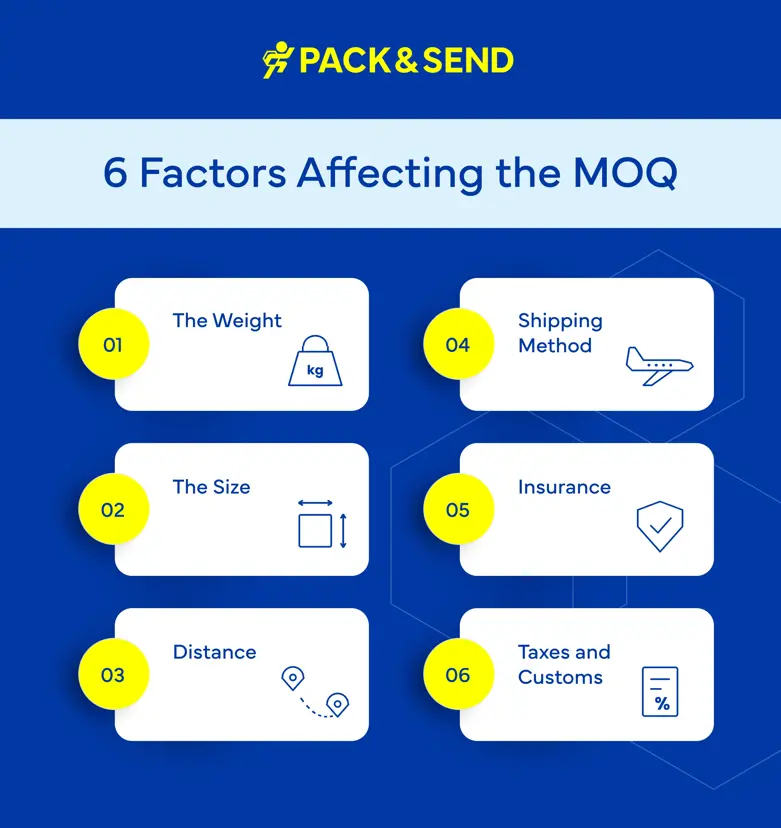
-
Demand Variability: If your demand is less variable and largely stable or predictable, setting an MOQ becomes comparatively easier.
-
Forecast Accuracy: Forecasting accuracy and seasonality usually require you to set tighter MOQs to help businesses stay profitable.
-
Carrying Cost Percentage and Storage Capacity: Since carrying costs can be a big chunk of your inventory value, and over-ordering can erode your margins, it is important to set lower MOQs.
-
Manufacturing Constraints: Manufacturers and retailers with longer setup times or lead times must set higher MOQs. Maintain shorter lead times and flexible manufacturing processes to lower MOQs and frequent orders.
-
Product Value, Shelf Life, and Risk of Obsolescence: Overstocking high-value and perishable items can be risky, so the MOQs for such products should be lower, and vice versa.
-
Order Fulfillment Strategy: Brands fulfilling several smaller D2C orders must set higher MOQs with factories while holding safety stock.
Now that we have explored the contributing factors, it is time to look at the step-by-step process. While there is no universal minimum order quantity formula, you can use the following five-step process to get started.
Step 1: Assess Demand
Consider the combination of your product type, seasonality, and competition to forecast demand and inform your purchase orders.
For instance, if you sell fashion jewellery on your online store and forecast sales of 850 units for finger rings for the next 6 months. In this case, if the supplier has an MOQ of 1000 units, you can easily place the purchase order, as there is not much difference, and contribute to your safety stock.
However, if your online store sells perishable goods like food items or skincare products that have a definitive expiry date, then a similar difference in your forecasted demand and the supplier’s MOQ may not be acceptable and may motivate you to negotiate with them.
Step 2: Consider Break-Even Point and Holding Costs
Calculating the break-even point is important in determining the MOQ for your suppliers and end-customers, as it is the no-profit-or-loss point for businesses. eCommerce stores must set the MOQ above the break-even point to ensure they make a profit.
You must also consider the cost of holding excess stock of a specific product in your inventory. For such products, suppliers might be motivated to set high MOQs to push out more stock, and buyers may hesitate to agree to high MOQs to avoid increasing their inventory costs.
Step 3: Determine Your MOQ
Once you have gathered all this information, you can set the right MOQ for your business.
Suppose your online toy store has forecasted the sales demand as 200 units for the upcoming month. The break-even point for this product is $3, and its holding cost is $1 per unit.
The total procurement and holding cost for storing all 200 units in your inventory is $800. As a retailer, you must set the price of every product unit to $4. With that in mind, your MOQ calculation must consider the unit price to be $5 or more.
Finally, you can set the MOQ based on your profit goals and unit price.
Step 4: Inform Existing Customers
Once you have successfully set your MOQs, you must communicate the changes clearly to your account managers and B2B customers (if applicable).
Provide an adequate rationale for the changes and, if possible, implement a notice in advance that defines a transition period where old and new MOQs can coexist.
In your minimum order quantity letter to customers, motivate them to adapt to the MOQs by providing improved lead times, better payment terms, and higher tiers.
Communicating MOQ-related information promptly and clearly can reduce friction for SMEs that are sensitive to higher minimums.
Step 5: Enforce MOQ
Once you have set the MOQ with fair practices and offer clear and timely communication to customers, you can enforce the MOQ in your ordering and other eCommerce systems.
Configure your WMS, ERP, and storefronts to ensure that your order quantities align with the defined minimums and case breaks.
Train your sales and customer support teams to ensure any exceptions to MOQs are rare and justified. Review the exception data to refine your MOQs and adjust pricing if customers insist on lower minimum quantities.
4 Major Challenges of MOQ
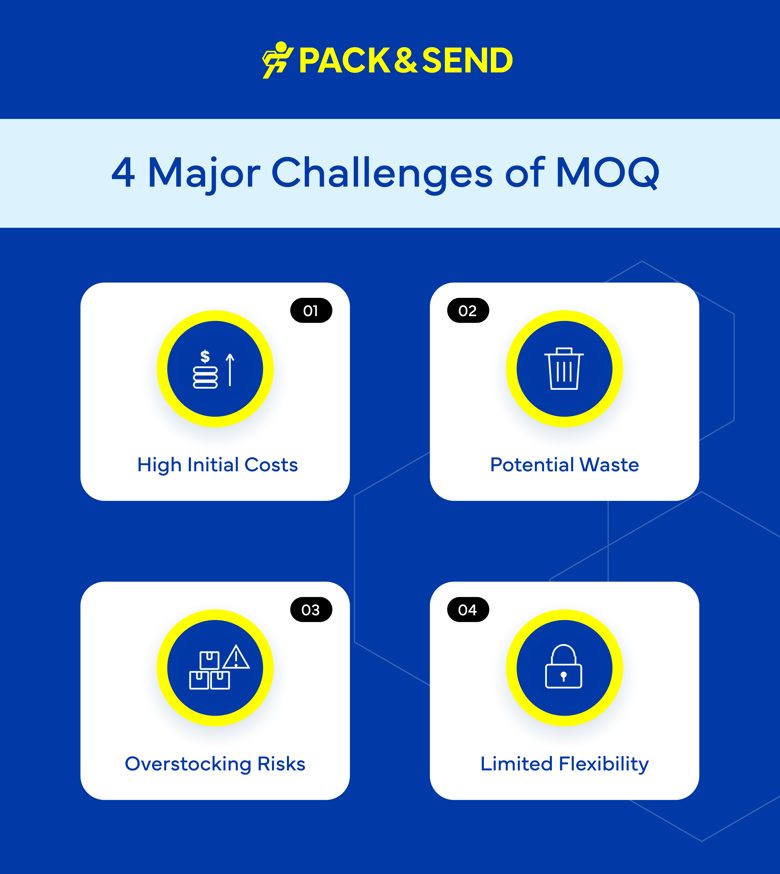
Now that we have covered the importance and process of setting wholesale minimum order quantities for your products, let us explore the primary challenges companies may face:
1. High Initial Costs
For smaller eCommerce stores, higher MOQs can strain liquidity and cause issues, as they require cash upfront. If your carrying costs are high, the pricing and sales process can be expensive even if you get a good bulk deal.
High initial costs can complicate your investment in marketing, new products, or technology, as the working capital is locked up in vendor-managed inventory.
2. Potential Waste
If the MOQs for perishable or seasonal products are too high, they risk expiry and even obsolescence.
For sectors like beauty and fashion, unsold stock is often discounted or scrapped, diluting your profits or creating sustainability issues.
In 2026, consumers are more likely to focus on observing how companies handle sustainability and waste. Thus, brands are trying to be leaner or more responsive, conflicting with corporate ESG commitments.
3. Overstocking Risks
High MOQs can often motivate you to buy more product units than you need, resulting in overstocking, especially if your demand forecasts are optimistic.
Handling excess stock can not only increase your carrying cost and cause storage congestion, but also increase the risk of slow-moving or dead stock.
Poorly calibrated or no minimum order quantity can make it harder to effectively manage your inventory, and drag down your turnover and ROI.
4. Limited Flexibility
B2B eCommerce stores with rigid MOQs can make demand-driven replenishment harder for brands that are looking to test new SKUs or channels.
High MOQs can reduce your ability to adapt to customer preferences or product upgrades. Such rigidity can also overcomplicate your omnichannel retail operations, where stock must be distributed between online and offline channels.
Understanding High MOQ vs Low MOQ
You have now already understood that you might need to set your MOQs high or low, depending on your business goals. Whether your MOQ is high or low, you can achieve different strategic purposes for your business. In 2026, eCommerce brands are more likely to adopt a hybrid approach, supported by agile suppliers or nearshoring partners.
Ensure you choose the right approach for your products and business by understanding the specifics of high and low MOQs individually.
1. High MOQ
You must set high MOQs for customised products or products that require complex manufacturing setups, or when you are looking to protect your margins. The benefits of high MOQ include lower production efficiency and unit costs, and cash flow pressure and overstocking are the major risks.
2. Low MOQ
Usually implemented in dropshipping or flexible manufacturing environments, low MOQs can help eCommerce businesses optimise for variety and accessibility. The benefits of low MOQ are lower inventory risk and better innovation agility, and the risks are higher shipping and unit costs.
8 Best Practices to Consider When Managing MOQ
Now that we have covered the basics of implementing MOQ to your advantage, let us look at the actionable steps and best practices you must consider in the process:
1. Remove Slow-Moving Products
It may be tempting to attempt to boost sales of your slow-moving products by setting MOQs for them, but that might not be the best idea. Identify SKUs with low turnover, longer holding periods, or repeated markdowns, and consider discontinuing them.
Focus on high-performing products that make your MOQ negotiations simpler and improve turnover. Reduce slow movers to free up working capital and be redirected towards faster-moving SKUs.
2. Improve Inventory Turnover
By successfully improving your inventory turnover, you can lower the stock levels for each SKU and subsequently support lower MOQs over time.
The best techniques to cut excess stock and boost inventory turnover include shorter lead times, better demand forecasting, and just-in-time replenishment. By improving your inventory turnover, you can negotiate better MOQs with your suppliers.
3. Evaluate Your Supplier or Distributor Options
The same product can be assigned different MOQs by different eCommerce retailers based on their risk tolerance, operational scale, and processes. Benchmarking alternative distributors or manufacturers periodically can help you identify lower MOQs or better pricing.
Choose suppliers with a higher unit cost and a lower MOQ, as it is economically better for cash flow and carrying costs.
4. Automate Using Technology
Utilise modern order management and inventory management software to automate reorder points, purchase proposals/orders, and demand forecasting to inform your MOQ decisions. Such systems can integrate lead times, sales history, and safety stock to propose order quantities that make economic sense.
Bringing automation into the process can also help you enforce MOQs across customers and channels, thus reducing exceptions and manual errors.
5. Negotiate a Lower MOQ
In most cases, MOQ is negotiable, especially if you can offer longer contracts, better forecasts, or consolidated SKUs in return. Conversely, the suppliers of your online store may be convinced to lower their MOQs for new products or in exchange for deposits and purchase commitments.
The negotiation tactics must include mutually beneficial proposals, risk reduction, and better outcomes.
6. Communicate Transparently with Suppliers
Have open communication with your suppliers about the demand patterns, growth plans, and promotion calendar, helping them plan capacity and have more flexibility with MOQs. Joint business planning that includes shared forecasts and regular reviews creates trust and justifies exceptions.
The increasingly volatile environment and visibility into demand variability in 2026 make it important for suppliers to become partners, rather than just transactional buyers.
7. Choose Stock Over Custom Products
Dealing with custom products usually entails higher MOQs as they involve bespoke tooling, artwork, or materials.
When customer demand is uncertain, you must consider using standard or semi-custom stock products that have high production volumes, enabling lower MOQs. This approach is useful for components, packaging, and accessories where customisation adds complexity but not as much customer value.
8. Offer Free Shipping Thresholds
Free shipping thresholds can function as a demand-side MOQ as they motivate customers to order more in every order or transaction. Aligning free shipping thresholds with your internal MOQ and fulfillment economics helps you increase basket size without diluting profit margins.
What Does the Future of MOQs Look Like?
The future of MOQs is driven by three major trends: supply chain volatility, digitisation, and sustainability.
If your shipping operations experience volatile lead times and demand shocks, you can encourage more scenario-based MOQ modeling rather than static rules, especially in global supply chains.
Digitisation in supply chains and AI-driven forecasting allows businesses to conduct granular and dynamic MOQs by channel, season, or customer tier. Additionally, sustainability pressures can also push brands to reduce overproduction and waste, and encourage more nearshore and flexible manufacturing.
Concluding Remarks
MOQ is the minimum quantity or number of units of a product that a customer must buy when placing an order. By offering MOQ for products, eCommerce stores and manufacturers can optimise production, manage costs, maintain profitability, and achieve economies of scale.
By calculating the MOQ of your products, you can boost your supply chain and inventory strategy while consistently facing challenges.
Contact us to work with a professional and experienced logistics provider that can help handle your order fulfilment smoothly.
Frequently Asked Questions (FAQs)
1. What does Minimum Order Quantity (MOQ) mean?
Minimum Order Quantity (MOQ) is the smallest number of units that an eCommerce company is willing to sell in a single transaction or order for specific products. MOQ is designed to ensure that each order is economically viable, considering the costs associated with production and handling.
2. How can setting the right MOQ improve cash flow and reduce inventory costs?
The right MOQ can limit overordering and keep inventory aligned with realistic turnover and demand, reducing the working capital tied up in stock. The annual inventory carrying costs can be a major chunk of the inventory value, optimising the MOQ and lowering the expenses.
3. What risks do businesses face if they ignore supplier MOQs?
Ignoring MOQs for suppliers can lead to higher unit prices, refused orders, or relying on last-minute expectations that can strain relationships. Disregarding supplier MOQs can cause unreliable supply, stockouts, and loss of priority.
4. How is MOQ different from EOQ (Economic Order Quantity)?
MOQ stands for Minimum Order Quantity and refers to the minimum quantity imposed by online stores to make transactions viable. On the other hand, EOQ refers to the optimal order quantity that minimise the total cost of ordering and holding inventory.
5. What factors should SMBs consider before deciding their MOQ in 2026?
SMBs must consider factors like carrying cost percentage, demand variability, warehouse capacity, available cash flow, and supplier lead times when negotiating flexible terms and MOQ.
6. How to decide what MOQ I should define for my products?
Start by analysing the demand, calculating holding costs, and modeling profitability at different points and batch sizes for each SKU. Choose the smallest order quantity that meets the risk and margin targets, adjust for packaging constraints, and validate with your sales and operations teams.
7. Is there a formula to decide MOQ?
Many eCommerce companies derive MOQ by combining different types of insights, such as break-even analysis, demand forecasts, and more. However, there is no universal formula for calculating MOQ, and it refers to the minimum quantity at which total revenue covers fixed and variable costs.