People planning international parcel shipping often ask, “How long does international shipping take?” The destination, service level, customs process, parcel details, and final address all change the answer.
So, how long does standard international shipping take from Australia in 2026? For standard air services to many major destinations, a practical planning range is around five to twelve business days. Some nearby routes can be faster. Remote destinations, customs checks, public holidays, incomplete paperwork, or restricted items can extend the timeline.
That estimate normally starts after dispatch and may exclude booking day, weekends, public holidays, customs holds, and failed delivery attempts.
This guide explains average international shipping times, the difference between standard, express, and economy services, how costs are calculated, what documents you may need, and how to reduce avoidable delays.
How Long Does Standard International Shipping Take from Australia?
Standard international shipping is usually designed to balance speed and price. It is generally slower than international express but faster than most sea freight options.
For people sending parcels overseas from Australia, standard airmail or standard air freight may arrive in approximately five to twelve business days. That range is only a guide.
The exact estimate depends on:
-
The origin and destination postcode
-
Whether the address is metropolitan, regional, or remote
-
The service and transport mode selected
-
Collection time and dispatch cut-offs
-
Customs processing at the destination
-
The parcel’s contents, value, weight, and dimensions
-
Local weekends and public holidays
-
Whether the recipient is available to accept delivery
PACK & SEND’s international parcel services offer standard airmail at roughly five to ten business days, depending on the destination. Destination-specific estimates vary. Standard air freight may take three to seven business days to New Zealand, five to ten to the United States, six to twelve to the United Kingdom, and seven to twelve to Canada or parts of Europe.
These are expected transit ranges, not guaranteed arrival dates. When a deadline is firm, share the required delivery date before booking rather than choosing a service based only on its name.
The journey includes preparation, collection, export processing, international transit, customs, and final-mile delivery. A parcel marked “in transit” may be moving between facilities, waiting for a flight, or passing through customs. Our guide to the meaning of in-transit explains why scan gaps do not always signal a problem.
Standard, Express, and Economy International Shipping: What’s the Difference?
The three labels describe different priorities. They do not follow one universal industry definition, so always compare the actual quoted timeframe, inclusions, tracking, and restrictions.
|
Service |
Typical Use |
General Speed |
Cost Position |
|
Express |
Urgent documents, samples, valuable parcels |
Fastest air option |
Highest |
|
Standard |
Everyday parcels and commercial goods |
Mid-range |
Moderate |
|
Economy |
Flexible deadlines and price-sensitive parcels |
Slower air or consolidated service |
Lower |
|
Sea freight |
Large, heavy, or high-volume freight |
Several weeks |
Often best for volume |
Standard International Shipping
Standard international shipping is the middle-ground option. It usually travels by air but may receive a lower priority than express shipments or move through a more consolidated network.
It suits:
-
Gifts and personal parcels without a fixed near-term deadline
-
Routine stock replenishment
-
Product samples that are not urgent
-
Small and medium commercial consignments
-
Documents or goods where cost is important but sea freight is too slow
Tracking and final-mile visibility vary by destination. Confirm the standard international shipping time in business days, when it starts, and whether customs time is included.
Also, before booking, ask whether the quoted timeframe starts at collection, depot acceptance, or international departure. That distinction can shift the practical delivery window by a day or more.
Express International Shipping
Express shipping gives the parcel higher handling and transport priority. It usually includes faster air movement, more frequent tracking, and door-to-door delivery.
PACK & SEND’s international express shipping generally takes one to five business days, depending on the destination. Country-specific routes may differ.
Express works well for urgent documents, spare parts, samples, valuable goods, and eCommerce orders with a promised fast delivery window.
If you are comparing how long does express international shipping take, how long does international express shipping take, or how fast is international priority shipping, do not focus on flight time alone. Customs, destination restrictions, and an inaccurate address can still delay an express parcel.
For a broader comparison, our article on expedited shipping explains how priority services trade a higher price for a shorter delivery window.
Economy International Shipping
Economy services prioritise price over speed. The parcel may move through a consolidated network, wait longer between departures, or use a slower final-mile service.
Economy suits flexible deadlines, durable goods, lower-value parcels, and senders who prioritise price over frequent updates.
An economy air service is still different from sea freight. Sea freight is usually designed for larger or heavier consignments and can take several weeks. PACK & SEND advises that international sea freight commonly takes around six to ten weeks, while air freight often takes approximately five to ten days, depending on the route and service.
Do not choose economy for a birthday, event, tender deadline, installation date, or production stoppage unless the quoted delivery window provides enough buffer.
Average International Shipping Times by Destination
The table below gives broad planning ranges for standard air services from Australia. These ranges reflect common PACK & SEND destination estimates. They can change with the origin city, destination postcode, parcel, carrier schedule, customs processing, and local conditions.
|
Destination |
Indicative Standard Air Time |
Common Reasons For Variation |
|
New Zealand |
3–7 business days |
Biosecurity checks, regional delivery |
|
United States |
5–10 business days |
Customs volume, regional final mile |
|
Canada |
7–12 business days |
Distance, customs, remote addresses |
|
United Kingdom |
6–12 business days |
Customs documentation, local delivery |
|
Europe |
7–12 business days |
Country-specific customs and VAT |
|
Asia |
6–12 business days |
Destination rules and city access |
|
Other countries |
8–14+ business days |
Limited routes, transits, remote delivery |
Treat these numbers as estimates at the time of planning. Confirm the current delivery range when you book.
Shipping to New Zealand
New Zealand is one of the shorter international routes from Australia. Standard air freight commonly takes around three to seven business days, while express services may reach major centres in one to four business days.
Even across the Tasman, customs and biosecurity requirements still apply. Food, plant material, wooden items, outdoor equipment, and goods contaminated with soil can receive additional attention. A rural or remote destination may also require extra final-mile time.
For bulky or non-urgent freight, sea transit may take around two to six weeks, depending on the ports, schedule, and whether the shipment uses shared or dedicated container space.
Shipping to the United States And Canada
Standard air freight to the United States commonly takes around five to ten business days. Canada often falls closer to seven to twelve business days.
Allow more time for regional addresses, commercial goods requiring detailed classification, higher-value shipments, incomplete recipient details, customs queries, or severe weather.
Import rules can change. For business shipments, confirm current tariff, product, and customs requirements before dispatch rather than assuming a previous shipment will be treated the same way.
Shipping to the United Kingdom and Europe
Standard shipping to the United Kingdom often takes around six to twelve business days. Many European destinations fall around seven to twelve business days.
Europe is not one uniform customs destination. The required taxes, product rules, and clearance process can differ between the United Kingdom, European Union countries, and non-EU destinations.
A parcel can arrive in the destination country quickly but remain uncleared if the commercial invoice lacks a clear item description, Harmonised System code, country of origin, or realistic value.
Allow extra time around Christmas, Easter, summer holidays, and country-specific closures.
Shipping to Asia
Standard international shipping to major Asian destinations often takes around six to twelve business days. Some high-frequency routes are faster. PACK & SEND lists standard air freight at approximately three to seven business days to Singapore or Hong Kong, while Japan is commonly seven to twelve business days.
Asia includes highly varied markets. Documentation and import rules for Singapore, Japan, India, China, Indonesia, and other destinations are not interchangeable.
Check destination rules for food, agricultural goods, cosmetics, medicine, batteries, electronics, alcohol, textiles, and licensed commercial goods. Include accurate recipient contact details in case customs needs clarification.
Shipping to Other Countries
If you are asking how long does worldwide shipping take, routes to Africa, the Middle East, the Pacific, and less frequently served destinations may involve several transit hubs. A standard air estimate of eight to fourteen business days is a reasonable starting point for some routes, but remote areas can exceed it.
For example, PACK & SEND lists standard air freight to Nigeria at around eight to fourteen business days. Sea freight commonly takes five to ten weeks across many long-haul routes.
Confirm whether the quote covers the final address or only an airport, port, depot, or metropolitan zone.
What Factors Affect International Shipping Times?
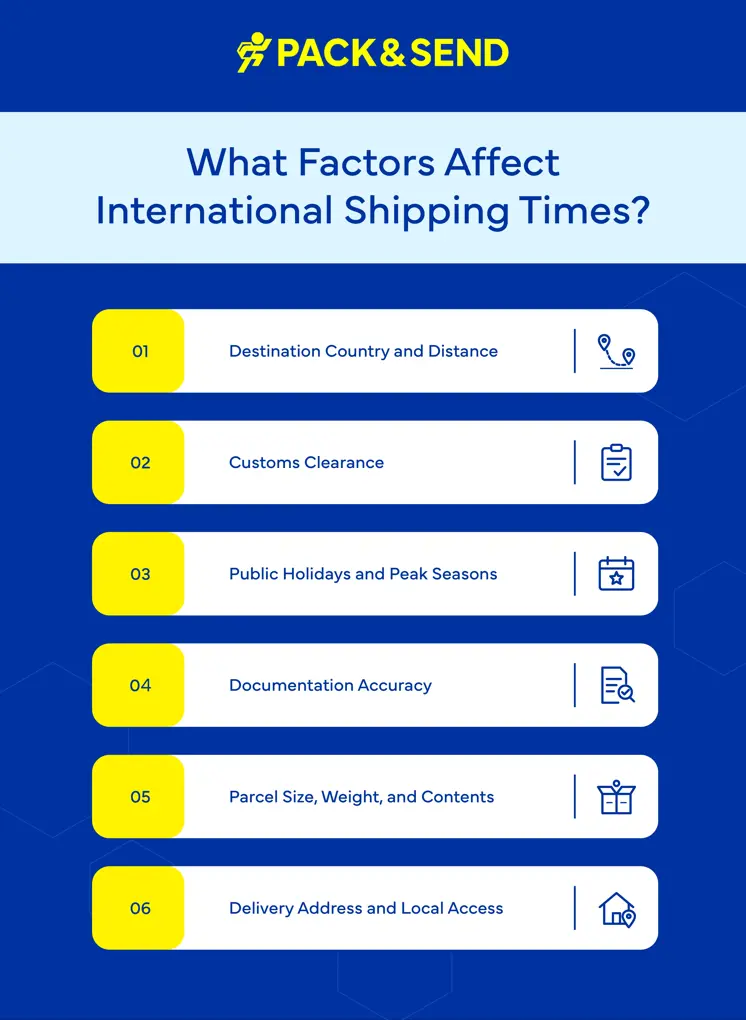
International shipping times are shaped by the full journey, not only the distance between countries.
Destination Country and Distance
Longer routes generally involve more flight time, connections, and handling. However, a nearby country with limited service frequency can take longer than a distant major hub with daily departures.
The destination postcode is often as important as the country. A metropolitan address may receive frequent deliveries, while a remote town, island, or rural property may depend on a less frequent local route.
Customs Clearance
Every international shipment crosses a customs border. Authorities may assess the contents, value, classification, origin, taxes, permits, and whether the item is prohibited or restricted.
Customs clearance may be quick when the documents are complete, and the goods are straightforward. Delays can occur when:
-
The description is vague, such as “parts,” “gift,” or “samples”
-
The declared value appears unrealistic
-
The Harmonised System code is missing or incorrect
-
The recipient has not paid duties or taxes
-
The goods require a permit, certificate, or inspection
-
Customs requests proof of purchase or further information
-
The item does not match the declaration
Australian Border Force export requirements apply before goods leave Australia as well. Goods must be reported through an Export Declaration or applicable exemption code, and some shipments require formal declarations before reaching a place of export.
Public Holidays and Peak Seasons
International shipping operates across multiple calendars. A normal business day in Australia may be a weekend or public holiday at the destination.
Peak periods can affect aircraft capacity, customs workloads, warehouse processing, and final-mile delivery. Christmas, Lunar New Year, major retail events, national holidays, severe weather, and transport disruptions are common pressure points.
Book earlier than the quoted minimum when the parcel is linked to an event, campaign, launch, or customer promise. Check holidays in both Australia and the destination country, especially when a parcel crosses multiple transit hubs. One closure can affect several connected stages.
Documentation Accuracy
Small paperwork errors can create large delays. The sender’s documents should match the parcel, label, invoice, and booking details.
Use a specific description such as “two cotton shirts” or “stainless-steel machine bracket” instead of “clothing” or “parts.” State the quantity, unit value, total value, country of origin, and reason for export accurately.
Do not describe a commercial sale as a gift to avoid duties. Customs authorities can reassess the parcel and request evidence.
Parcel Size, Weight, and Contents
To ship large or heavy parcels, you may need a freight handler rather than a parcel network. Some aircraft, vehicles, depots, or delivery agents also have size and weight limits.
Contents also affect routing. Batteries, liquids, aerosols, food, medicine, alcohol, biological material, and dangerous goods may face restrictions. Fragile or valuable items may need customised packing or handling.
Delivery Address and Local Access
A complete address should include the recipient’s full name, street and unit number, city, state or province, postcode, country, email, and local phone number.
Delivery can fail or pause when:
-
A building requires access approval
-
A business is closed
-
The recipient cannot be contacted
-
The postcode does not match the suburb
-
The location is outside a standard service zone
-
Duties are awaiting payment
-
No one is available to sign
Our guide to delivery exceptions explains how address issues, weather, damage, and other events can interrupt an otherwise normal journey.
How are International Shipping Costs Calculated?
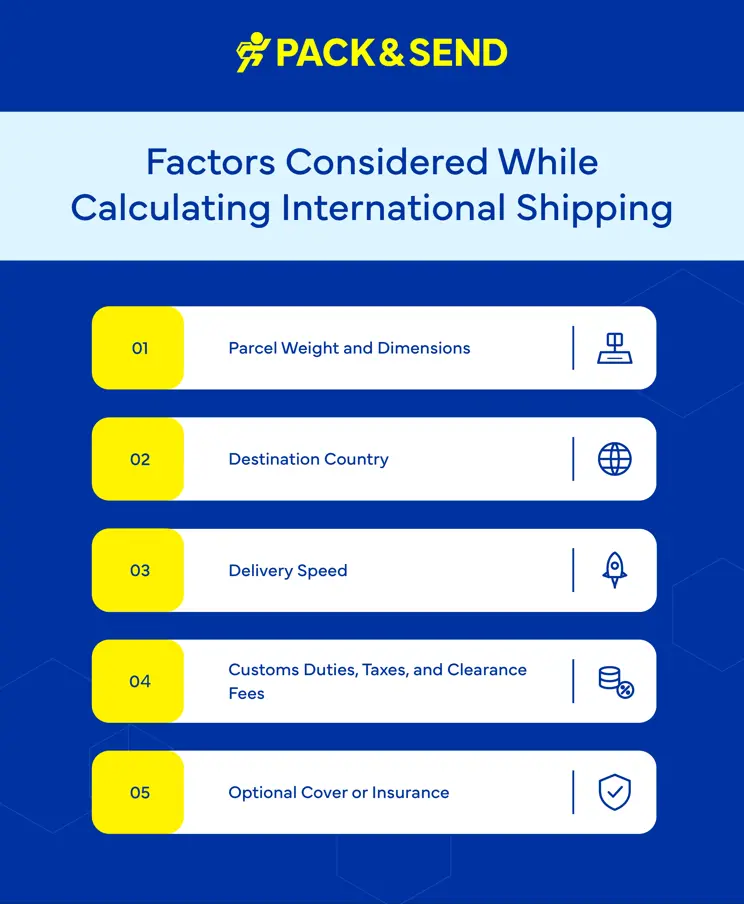
If you are asking how much does it cost to ship internationally, remember that international shipping prices depend on the shipment and service, not distance alone.
Parcel Weight and Dimensions
Carriers commonly compare actual weight with volumetric weight. Volumetric weight reflects how much vehicle or aircraft space a parcel occupies. The chargeable weight is often the higher figure.
This is why a large box containing a light item can cost more than expected.
Measure the finished parcel after packing:
-
Record length, width, and height at the widest points.
-
Weigh the complete package, including the carton and cushioning.
-
Check whether protrusions make the parcel irregular.
-
Use the service’s specified volumetric formula or request a quote.
Reducing space can lower international shipping charges, but do not remove essential cushioning merely to make the carton smaller.
Destination Country
Routes with high service frequency may cost less than destinations requiring multiple transfers or specialist final-mile delivery.
Remote areas, islands, conflict zones, and regions with limited infrastructure can attract surcharges. The destination’s customs process can also create brokerage or clearance charges.
Delivery Speed
Express services cost more because they receive higher transport priority and tighter handling schedules. Standard shipping usually offers a more moderate price. Economy or sea freight can reduce transport cost when the deadline is flexible.
A lower shipping price is not always lower total cost. A delayed spare part, missed event, stockout, or lost customer can cost more than the difference between standard and express.
Customs Duties, Taxes, and Clearance Fees
The transport quote may not include duties, taxes, import permits, inspections, storage, or customs brokerage at the destination.
Confirm who pays import charges, whether duties can be prepaid, what clearance includes, and who bears return or disposal costs if delivery fails.
These charges are set by destination authorities and are separate from the international shipping pricing itself.
Optional Cover or Insurance
Consider the full replacement cost, not only the purchase price. Loss or damage may also cause re-manufacturing, re-shipping, labour, customer refunds, or project delays.
PACK & SEND offers an optional Freight Plus Warranty for physical loss or damage in transit. Read the terms, exclusions, packing requirements, and claim process before relying on any cover.
For a current price for international shipping, provide accurate packed dimensions, weight, contents, value, destination, and deadline. PACK & SEND’s online quote tool can quote many pre-packed parcels under 30 kilograms, while a Service Centre can assess larger, unpacked, fragile, or complex shipments.
Documents Required for Standard International Shipping
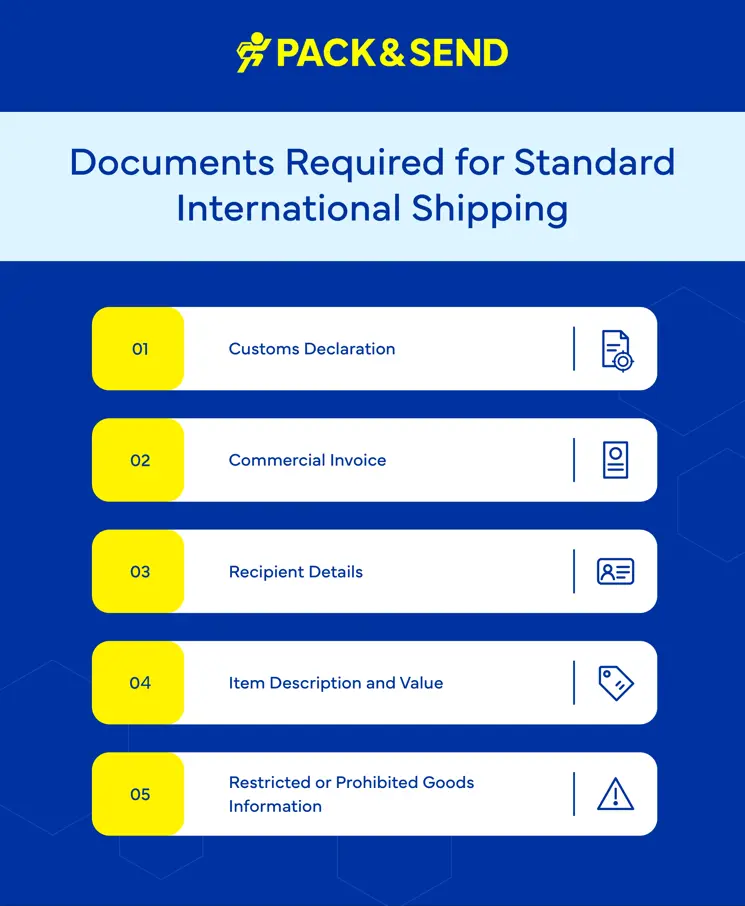
Anyone learning how to ship a package internationally should start with the paperwork. Requirements depend on the goods, value, destination, and reason for sending.
Customs Declaration
A customs declaration tells authorities what the parcel contains, where it came from, where it is going, and what it is worth.
It should match the physical contents exactly. Do not omit items or use blanket descriptions.
Australian exports are subject to customs control. The Australian Border Force explains when an Export Declaration is required. The requirement depends on the shipment’s value, goods, and circumstances.
Commercial Invoice
A commercial invoice is commonly required for goods with commercial value. Gifts and samples may still need a pro forma invoice or equivalent customs document.
A useful invoice includes sender and recipient details, invoice date, precise item descriptions, quantities, values, currency, country of origin, Harmonised System codes, reason for export, and relevant delivery terms.
The Australian Government’s guidance on documents for exporting covers commercial invoices, packing lists, certificates of origin, and transport documents.
Recipient Details
Use complete, locally usable recipient details, including an international-format phone number and email. For businesses, add the company, department, importer or tax number where required, and a customs contact.
Tell the recipient when the parcel has shipped and share the tracking number. PACK & SEND’s track and trace service provides scan-based updates across its multi-carrier network.
Item Description and Value
Customs needs more detail than the product category alone. Describe what the item is, what it is made from, and its intended use when relevant.
Use the real transaction value. For gifts, samples, returns, or free-of-charge goods, declare a reasonable customs value rather than zero.
Harmonised System Codes classify traded products and appear on documents such as commercial invoices, bills of lading, and customs declarations.
Restricted or Prohibited Goods Information
An item accepted in Australia may be prohibited, restricted, licensed, or taxed differently at the destination.
Check both:
-
Whether the item can leave Australia
-
Whether it can enter the destination country
-
Whether the chosen service accepts it
-
Whether special packaging, labelling, or documents apply
Check before packing. Where uncertain, ask a PACK & SEND Service Centre and the relevant government authority.
How to Reduce International Shipping Delays?
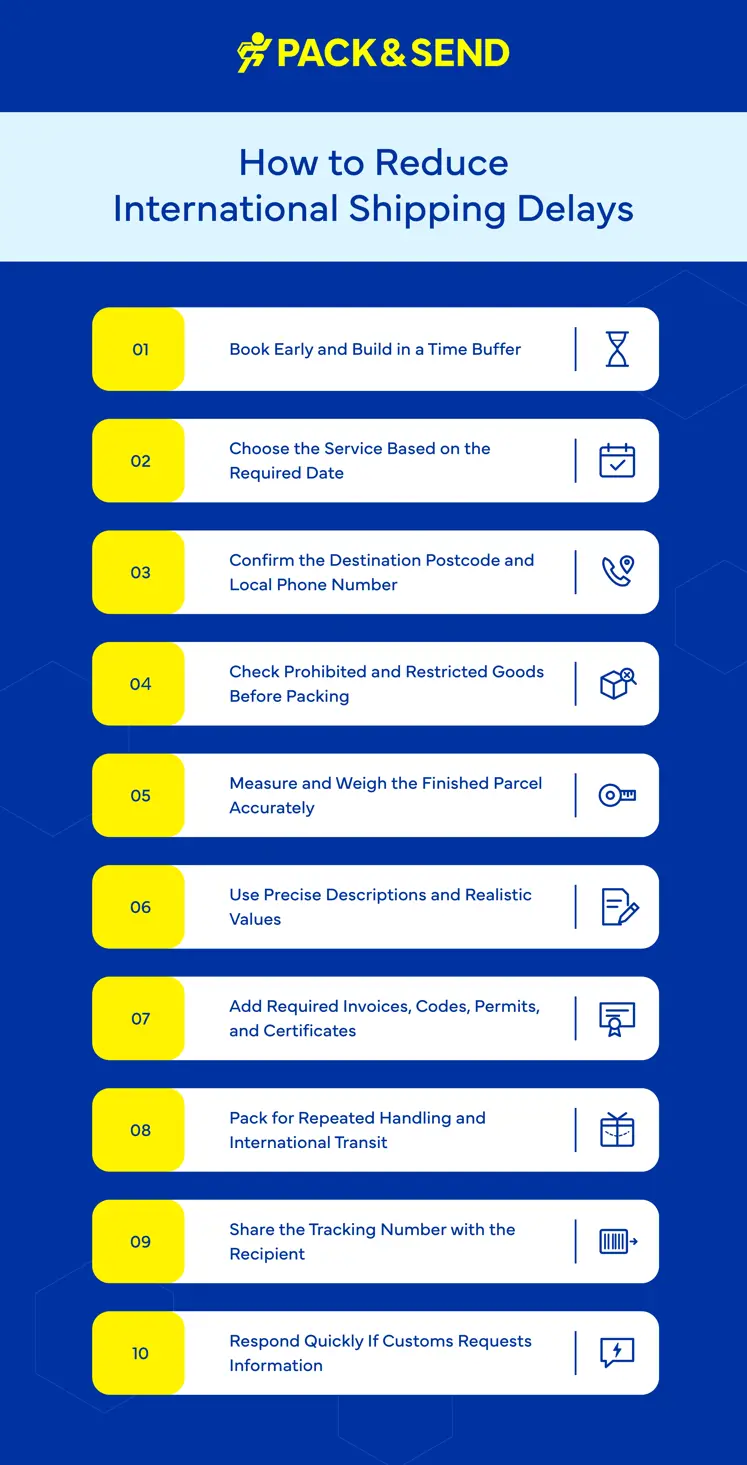
You cannot control weather, customs workloads, or every network disruption. You can remove many preventable causes.
To shorten shipping delays and improve the answer to “how long does international delivery take?”, use this checklist:
-
Book early and build in a time buffer.
-
Choose the service based on the required date.
-
Confirm the destination postcode and local phone number.
-
Check prohibited and restricted goods before packing.
-
Measure and weigh the finished parcel accurately.
-
Use precise descriptions and realistic values.
-
Add required invoices, codes, permits, and certificates.
-
Pack for repeated handling and international transit.
-
Share the tracking number with the recipient.
-
Respond quickly if customs requests information.
Frequent senders can maintain approved product descriptions, HS codes, origin data, and packing instructions. For critical deadlines, confirm whether collection, customs, weekends, and remote delivery are included. Choose express if standard leaves no sensible margin.
10 Common Packing Mistakes that Delay International Shipping
Poor packing can cause repacking, refusal, damage, or an unreadable label.
Common mistakes include:
-
Using a weak or previously damaged carton
-
Leaving empty space that allows contents to move
-
Overloading a box beyond its strength
-
Using newspaper or soft clothing as the only protection for fragile items
-
Placing tape over barcodes or customs pouches
-
Allowing old labels to remain visible
-
Sending leaking containers or loosely closed liquids
-
Using packaging that does not suit batteries or regulated goods
-
Failing to protect sharp edges
-
Measuring the parcel before final packing
Choose a rigid carton only slightly larger than the protected contents. Add cushioning around every side, fill voids, reinforce seams, and keep labels flat and visible.
Our easy packing tips cover carton selection and cushioning, while our guide to packing cargo for shipping explains why international freight must withstand multiple handling points.
Fragile, valuable, or oversized items may need custom foam, crating, palletisation, or professional packing.
Concluding Remarks
So, how long does standard international shipping take? For many major destinations from Australia, plan for around five to twelve business days by standard air service. Nearby destinations may be faster, while remote routes, customs checks, public holidays, incomplete documents, or restricted goods can add time.
A reliable delivery plan starts with the required arrival date. Then choose the service, confirm the destination estimate, prepare accurate documents, pack for international handling, and build in a sensible buffer.
PACK & SEND provides international shipping from Australia for documents, parcels, fragile goods, commercial consignments, and larger freight. The team can help compare express, air, and sea services, prepare the shipment, and guide you through the paperwork.
Contact us for a current delivery estimate and international shipping option suited to your parcel, budget, and deadline.
Frequently Asked Questions (FAQs)
1. How Long Does Standard International Shipping Take from Australia?
Standard air shipping to many major destinations generally takes around five to twelve business days. New Zealand can take three to seven business days, while routes to Canada, Europe, or more distant destinations may sit toward the upper end or beyond it.
2. What Factors Affect International Shipping Times from Australia?
The destination, service level, customs clearance, public holidays, carrier schedules, parcel size, contents, documentation, and final delivery address can all affect the timeline. Remote delivery and restricted goods may add more time.
3. What’s the Difference Between Standard, Express, and Economy International Shipping?
Express prioritises speed and normally costs more. Standard balances delivery time and price. Economy is slower and often cheaper, while sea freight is a separate option suited to larger, heavier, or less urgent consignments.
4. How Do Customs Delays Affect Delivery Timelines?
Customs delays can add days or longer when information is missing, duties remain unpaid, or the goods require inspection, permits, or further evidence. Accurate descriptions, values, codes, and recipient details reduce avoidable holds.
5. How is International Shipping Cost Calculated from Australia?
Pricing depends on actual or volumetric weight, dimensions, destination, service speed, contents, handling, remote-area charges, and optional cover. Duties, taxes, brokerage, and storage may be separate.
6. What Documents are Required for Standard International Shipping from Australia?
Most shipments need a customs declaration and accurate recipient and item details. Commercial goods may also require a commercial invoice, packing list, Harmonised System codes, certificates, permits, or a formal Export Declaration.