
Imports and Exports can be a little tricky. The laws for customs clearance in Australia as well as the applicable charges can differ depending on the goods, country of origin, and value. It is a complex web to navigate, especially when dealing with different types of goods. Understanding the Australian customs clearance process is even more important if you wish to facilitate Delivered Duty Paid (DDP) shipping for your customers.
As of 2026, the Australian Border Force (ABF) has introduced several digital tools and policy updates aimed at improving efficiency, enforcing compliance, and reducing clearance delays. Whether you are managing bulk shipments or personal effects, staying informed of these changes is critical.
This article sheds light on the Australian laws, procedures, and charges concerning the import and export of goods. The information shared in the article is sourced from the Australian Border Force, the authority for the customs clearance process in Australia.
What is Import Customs Clearance in Australia and How Does It Work?
Organisations and individuals can import goods into Australia without an import licence. But, any item brought into the county must undergo customs clearance in Australia. You also need special permits from customs control to import certain types of goods.
In 2026, the Australian Border Force (ABF) continues to enforce strict biosecurity and compliance protocols. Importers must now pay closer attention to tariff classification, permit requirements, and accurate valuations, as missteps may result in customs delays or enforcement penalties.
Let’s look at the process and requirements for Australian customs clearance.
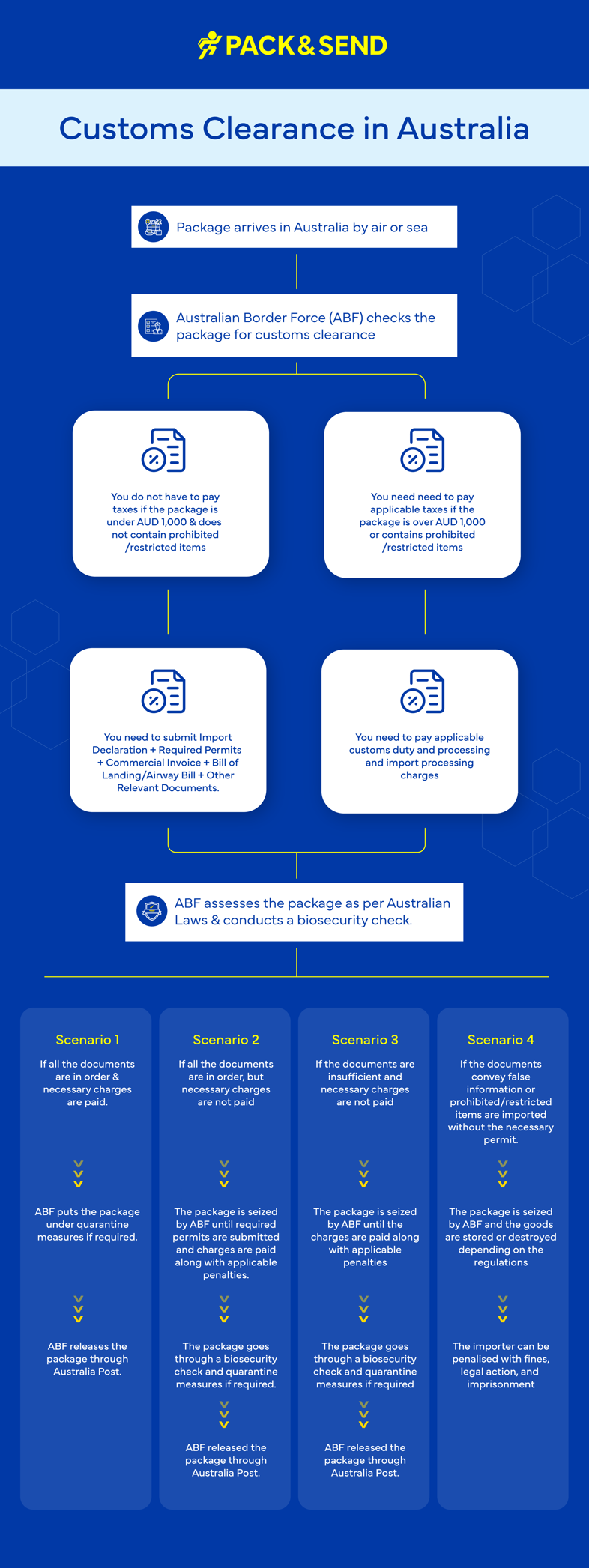
What are the Steps in the Import Customs Clearance Process?
All imported goods have to follow the below procedure for customs clearance in Australia:
- The customs clearance process begins when goods enter an Australian seaport or airport.
- The Australian customs clearance process is conducted by the Australian Border Force (ABF).
- All the goods are checked based on the labels, cargo report, and import declaration associated with them.
- All goods also need to clear biosecurity checks and quarantine measures as necessary.
- After the customs clearance is complete, ABF hands over the goods to Australia Post.
- Any items that do not fulfil customs requirements are seized by the ABF and necessary actions are taken against the importer.
In 2025 and 2026, the Australian Border Force has placed increased emphasis on early and accurate digital lodgement through the Integrated Cargo System (ICS). Incomplete documentation, incorrect tariff classification, or missing permits are among the most common reasons for a customs clearance delay. Where information is incorrect or inconsistent, goods may be held under customs clearance control until issues are resolved.
In such cases, working with experienced customs clearance agents or a licensed broker for customs clearance can help reduce processing time and avoid unnecessary delays.
Let’s understand the requirements, procedures, and documents to complete customs clearance in Australia.
What are the Labelling Requirements for Import Customs Clearance in Australia?
You need to label certain international parcels for customs clearance in Australia. Though not all goods need labelling. You should refer to the Commerce (Trade Descriptions) Regulations 2016 to see which types of goods require labelling for Australian customs clearance. The regulation also states the type of labelling required for different types of goods.
The goods that require labelling must also have a trade description to be allowed in Australia. This label is checked at customs clearance to understand the type of goods contained in a package. The Australian Border Force can seize the package if the label or trade description contains false or misleading information.
The trade description on the label should fulfil the following requirements:
- It should be in English language and express the information in prominent and legible characters.
- It should include the name of the country of origin, where the goods were produced.
- It should provide a true description of the goods.
- The trade description should be in the form of a principal label.
- It should be attached to the package in a prominent position and permanently affixed.
If your goods are packed together then you need to put the label in a prominent position on the pellet. In such cases, individual goods need not be labelled.
In 2026, the Australian Border Force continues to enforce trade description requirements strictly. Goods found with incorrect, vague, or foreign-language-only labelling are among the top causes of a customs clearance delay. For textile, food, cosmetic and electrical items, importers should cross-check the latest labelling guidelines under the Trade Descriptions Act and ensure labels are applied before goods are loaded for shipping.
If you're importing high-risk goods or unsure of your labelling obligations, it may be worth consulting a customs clearance company or using a customs clearance service that offers pre-shipment checks.
What Documents are Required for Import Customs Clearance?
You will need to submit a few documents to Australian Border Force to acquire a permit to import goods. The documents can be submitted by individuals and organisations. You will need the following documents to acquire an import customs clearance.
- Commercial Invoice
- Bill of Landing (for sea freight) / Air Way Bill (for airfreight)
- Other Documents (Depending on the type and value of Goods)
- Import Declaration
If all your documents are in order, it can significantly cut down Australian customs clearance time. Let’s understand each of the documents in further detail.
In 2026, ABF continues to prioritise electronic document lodgement via the Integrated Cargo System (ICS). Paper-based submissions are still accepted for smaller importers, but electronic declarations reduce errors and help prevent customs clearance delays.
If your shipment is valued over AUD 1,000 or involves controlled goods, you must ensure that import customs clearance has started before the cargo arrives in Australia to avoid holdups or additional storage costs.
If you are working with a customs clearance agent or a customs clearance company, they will typically gather and lodge these documents on your behalf.
What Is a Commercial Invoice and Why Is It Required for Customs Clearance?
The commercial invoice should include details such as the date of issue, invoice number, tariff classification code, the value of goods, weight, product name, quantity, means of transport, country of origin, etc. This document is issued by the exporter and serves as proof of purchase at customs clearance.
As of 2026, Australian Border Force (ABF) expects commercial invoices to be clear, itemised, and compliant with the customs valuation guidelines. The declared value on the invoice must match the transactional value of the goods up to the point of export, and must be expressed in Australian dollars using the exchange rate on the date of export.
For personal effects customs clearance or goods shipped free of charge (e.g. samples or gifts), the invoice should still reflect a fair market value to avoid rejection by customs officers.
Ensuring your invoice includes the correct tariff classification code is also essential, as misclassification is one of the leading causes of customs clearance delay in 2025 and 2026.
What is a Bill of Lading or Air Waybill and Why Is It Important for Customs Clearance?
You need a Bill of Landing for sea cargo customs clearance and an Air Way Bill for air freight customs clearance. This document needs to include information about the transport vessel, schedule, consignment, and so on.
In 2026, ABF requires that the transport document matches the import declaration exactly. Mismatches between the Air Waybill or Bill of Lading and the commercial invoice or declaration are a common trigger for a customs clearance delay.
If you're using sea freight customs clearance, your Bill of Lading should clearly include the port of loading and discharge, full container tracking numbers, and shipper/consignee details. For air freight, ensure the Air Waybill includes accurate weights and dimensions, as discrepancies are now more likely to trigger an inspection.
Using a customs clearance service or working with a licensed customs clearance broker can help catch these issues before lodgement.
What Other Documents Might Be Needed for Import Customs Clearance?
Depending on the type of imported goods, you may need additional documents such as a certificate of origin and import permit. Such documents are required if you are awaiting customs clearance for restricted goods, food items, prohibited items, dangerous materials, and so on. You need to acquire a permit from the respective Australian government authority.
As of 2026, additional scrutiny applies to certain product categories like electronics, personal protective equipment (PPE), and lithium batteries. For these, Safety Data Sheets (SDS) or test reports might be required at the time of customs clearance.
For items flagged under biosecurity risk (e.g. foodstuffs, wooden packaging, animal products), ensure the import permit is issued by the Department of Agriculture, Fisheries and Forestry (DAFF). A mismatch or absence of this documentation can delay clearance at the border.
Consider engaging a customs clearance broker if you’re unsure which specific import documents apply to your shipment. They can ensure you meet both standard and tariff-specific document requirements.
What is an Import Declaration and When Do You Need One?
An import declaration tells the ABF about the type of goods that you are importing and what you plan to do with those goods after you have completed the customs clearance process in Australia. We will discuss different types of import declarations below to understand how you can use them.
Import Declaration - An In-depth Look
An import declaration is necessary for customs clearance in Australia for certain types of goods. This declaration helps the Australian Border Force assess whether the goods are permissible in the country. Import declaration also clarifies the purpose of the imported items.
As of 2026, all import declarations must be submitted electronically through the Integrated Cargo System (ICS), which is now mandatory for commercial importers. Paper-based forms are no longer accepted for high-value or regulated consignments.
You must also ensure the use of correct tariff classifications under the latest Harmonised System (HS) 2022 revision, adopted by Australia for customs clearance. Incorrect classification can lead to delays, rejections, or penalties.
Based on the purpose of imported goods, you need to understand the following types of Import Declarations.
Types of Import Declaration
There are three types of import declarations that you need to consider for the customs clearance process in Australia. These types are based on how the imported goods will be used after entering the country.
- Import Declaration (N10)
- Self-Assessed Clearance (SAC) Declaration
- Warehouse Declaration (N20)
Let us understand each of these import declarations in detail. We will also see the requirements for each type of declaration.
Import Declaration (N10)
This import declaration is applicable for goods that are intended to be sold in Australia or used for home consumption. You need this type of import declaration if the total value of imported goods is greater than AUD 1,000. Although, if you are awaiting customs clearance for restricted goods like tobacco or alcohol products, you need an import declaration regardless of the value.
You need to include the following details in your import declaration statement:
- Information about the imported goods
- Information about the importer (individual or organisation)
- Information about the mode of transport for importing.
- Tariff classification and value of the goods.
Based on the means of transport, you will need to fill out the following import declaration forms for Australian customs clearance.
- If the goods are arriving in Australia through ocean freight, you need to submit a B650 form.
- If the goods are entering Australia by air freight, you need to submit a B374 form.
The importer or their customs clearance company must present an import declaration at an ABF counter. The declaration must be complete, signed, and stamped as necessary.
The importer can also submit the declaration for import customs clearance through the Integrated Cargo System (ICS).
Important 2026 update: Form B650 (sea freight) and Form B374 (air freight) are still applicable; however, submission must now happen via ICS only. In-person submissions at ABF counters are no longer supported for these forms.
Self-Assessed Clearance (SAC) Declaration
You need a SAC declaration if the value of imported goods is less than or equal to AUD 1,000. This declaration is valid if your goods arrive by air or ocean freight. It is not valid if the imported goods enter Australia through airmail, as personal effects (unaccompanied) or under a carnet.
If the goods need a permit for the Australian customs clearance process, regardless of value, you need to use the import declaration (N10).
You can only submit SAC declarations through Integrated Cargo Systems (ICS). This declaration can be submitted by a cargo reporter, a licensed customs broker, or customs clearance companies with access to ICS. You cannot submit a SAC declaration at an ABF counter.
There are three types of SAC declarations you need to consider:
1. Cargo Report SAC Declaration
- Must be submitted by Cargo Reporters to the ABF.
- Is valid for goods not mentioned in the SAC Thesaurus.
- Is not valid for prohibited and restricted goods.
- Is not valid for goods that are referred to the Department of Agriculture, Water and the Environment (DAWE).
2. Short Format SAC Declaration
- Must be submitted by the importer or custom clearance companies that represent them.
- Is valid for all goods not mentioned in the SAC Thesaurus, but not prohibited goods.
- Is valid for tobacco products, tobacco, and alcoholic beverages valued under AUD 1,000.
- Is valid for import of prohibited and restricted goods subject to inspection by ABF or DAWE.
- Is valid for goods that require biosecurity inspection and quarantine measures.
3. Long Format SAC Declaration
- Is valid for goods that are exempt from import processing charges and customs duties.
- Is valid for goods with applicable concessions.
- Is valid for goods that require a permit or approval.
- Is valid for importing goods that are part of a larger consignment.
Check ABF’s guidelines for SAC Import Declarations to find additional information such as required documents, permits, and customs clearance fees for different types of goods. Check the guidelines to ensure that you are reporting the appropriate SAC declaration for Australian customs clearance.
If you use the incorrect type of declaration, you may not fulfil the necessary requirements for the customs clearance process in Australia. These include paying applicable customs clearance fees, restricted goods permits, and biosecurity checks. Consequently, you may face penalties or legal actions from the government.
Warehouse Declaration (N20)
You can use this type of import declaration if you intend to store the imported goods in a warehouse before customs clearance. This type of declaration is only valid for goods valued above AUD 1,000.
You can submit the Warehouse Declaration (N20) form along with necessary documents in person to an ABF office. You can also submit it through the Integrated Cargo System (ICS). You do not need to pay duties or taxes until the goods undergo the customs clearance process. They can be stored indefinitely in a customs-licensed warehouse.
Once the goods are moved to the warehouse, you need to use Import Declaration out of the Warehouse (N30) form to use the goods for home consumption. But, you need to pay the required customs clearance fees, duties, and taxes before acquiring the warehoused goods. You also need to pay these charges if you want to export the goods to another country after clearing customs in Australia.
2026 note: ICS now allows warehouse operators to schedule clearance dates in advance and receive automated duty estimates based on real-time exchange rates.
How Do You Determine the Value of Imported Goods for Australian Customs?
You will need to declare the value of imported goods for AUS customs clearance. The declared value has a direct impact on several aspects of the customs clearance process in Australia. This includes the type of import declaration, customs clearance fee, applicable taxes, and so on.
You can evaluate the goods in several different ways depending on the type of goods. But, the most common method is to evaluate the goods based on the price paid for acquiring the goods, also known as transactional value. You can review the valuation guidelines by Australian Customs and Border Protection Service to learn more about setting the value for import declaration.
However, in 2026, increased scrutiny is placed on Production Assist Costs, royalty payments, and transfer pricing, especially for related-party transactions.
Key updates for 2026:
-
Goods must be valued in AUD based on the exchange rate on the date of export, as per ABF’s official rate calculator.
-
The Valuation Practice Statement has been updated to reflect recent World Customs Organization (WCO) guidelines, especially around intangible additions like software, design charges, and embedded IP.
-
If goods are free of charge, such as gifts or samples, customs value must still be assigned using market-based or comparable value methods.
If you are importing finished goods in Australia, you must declare the full value of Production Assist Costs. This is applicable to all finished goods that are made outside the country. Check the guidelines of Production Assists Costs to understand how you can evaluate such products.
You have to declare a value for AU customs clearance, even if the goods have no transactional value for you or are acquired free of charge (eg. gifts). Here are the guidelines to evaluate free-of-charge goods for Australian customs clearance.
The customs value must be assigned to the goods in Australian dollars (AUD). For Australian import customs, the valuation must be done as per the exchange rate on the date of export. You can refer to the Practice Statement on Valuation and Practice Statement on Transfer Pricing to understand how to evaluate your imported goods for Aussie customs.
Based on the value of the goods, you will need to file an import declaration and pay the necessary customs clearance fees.
What Customs Clearance Fees and Taxes Apply to Imports?
The Australian customs clearance fees and applicable taxes depend on several factors. These include the types of goods, the value of goods, the country of origin, and applicable concessions.
What Are the Current Customs Clearance Fees?
You do not need to pay customs fees in Australia for imported goods that are valued under AUD 1,000. But, this norm does not apply to tobacco, tobacco products, and alcohol. You need to pay customs entry fees in Australia along with other applicable charges for all goods valued higher than AUD 1,000.
The customs fee for Australia depends on the type of goods and the country of origin. For the majority of goods, the customs clearance fee is 5% of their value. You must check the current tariff classifications to check how your imported goods measure for different criteria.
On this page, you must first check the Schedule which pertains to the country of origin. This would tell you the applicable rates of customs duties for the goods. For example, if you are importing goods from Singapore, you need to check Schedule 4a.
You can use Schedule 1 to check if the country of origin can receive preferential rates. If not, you should check the applicable customs entry fee for Australian imports as per Schedule 3.
What are the Import Processing Charges (IPC)?
You will have to pay import processing charges alongside import declarations. The charges depend on the value of goods, type of goods, and type of import declaration. Please refer to the tables below to see the applicable IPC for your imports.
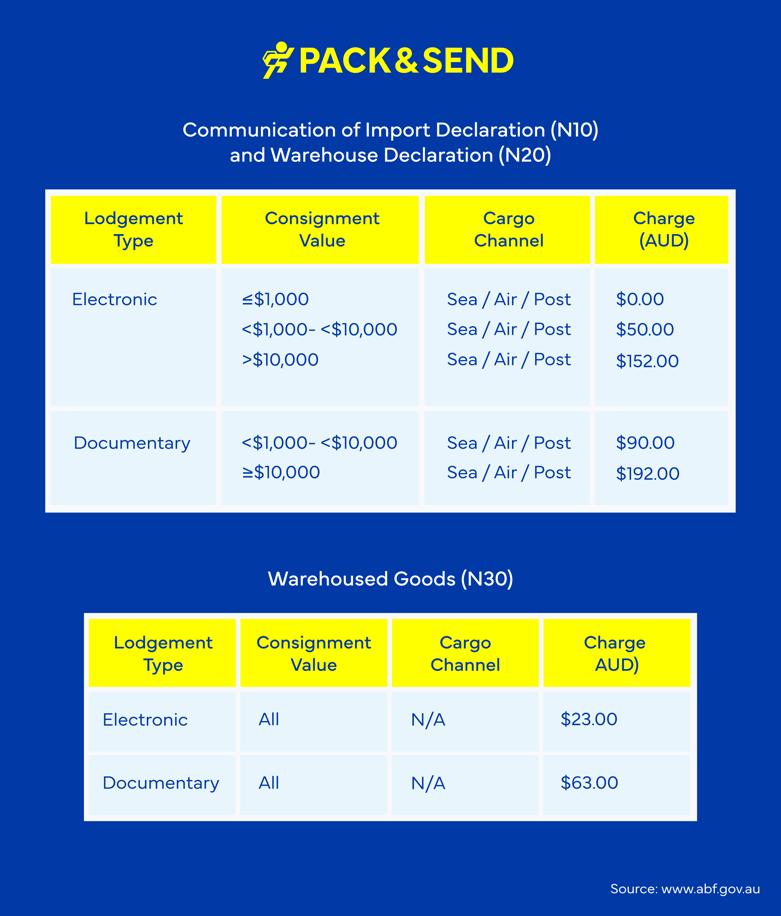
Aside from these, you also need to pay applicable biosecurity charges as per the table below:
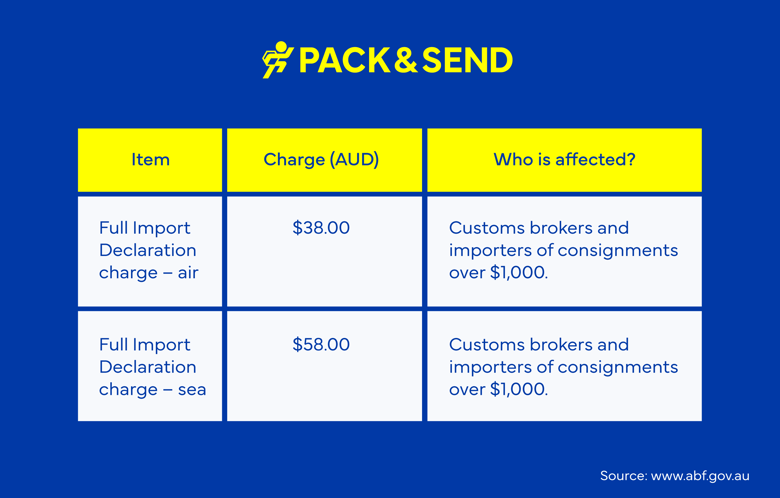
What Biosecurity Charges May Apply?
In addition to customs fees, goods subject to biosecurity controls may attract additional charges levied by the Department of Agriculture, Fisheries and Forestry (DAFF). These include:
-
Inspection fees
-
Quarantine facility costs
-
Treatment charges
Check the Biosecurity Cost Recovery Implementation Statement (CRIS) for the current charges and services.
How is GST Calculated on Imported Goods?
A GST of 10% is applicable to all imported items unless they are exempted from GST based on legislation. Here is a list of goods that are exempt from GST. For goods that are liable for GST, you need to calculate the tax based on the sum of the following values:
- Customs Value of the Imported Goods
- Payable Duties or Customs Fee in Australia
- Cost of Transportation and Insurance
- Any applicable Wine Equalisation Tax (WET)
You do not need to pay GST for Warehouse Declaration until the goods have completed the customs clearance process in Australia. For additional information on applicable GST and exemptions, you can review these GST guidelines by Australian Border Force.
Note: GST is not payable at the time of warehouse entry (N20). It becomes payable only when the goods are entered for home consumption (N30).
Aside from these charges, you may also be liable to pay Dumping and Countervailing Duties for certain types of goods. These charges are levied by AUS customs where Australian manufacturers are materially harmed owing to dumped or subsidised imported goods.
A Checklist of Best Practices for Import Customs Clearance
Here is an easy-to-remember checklist to help you complete the AUS customs clearance process:
- Check if the goods you are importing fall under the National Registration Scheme. If so, you need to register them before importing. Ensure that the goods you are importing are not prohibited or restricted in Australia.
- Check the BICON database & HS Code to see if your goods require an import permit.
- Make sure that your consignment adheres to the labelling requirements for Australian customs clearance.
- Check the valuation of your consignment as per the requirements of Australian Customs and Border Protection Services.
- Put together all necessary information and documents for Import Declaration and do not miss the deadline.
- Make sure that you file the correct import declaration with Australian Border Force or Integrated Cargo Systems.
- Check the current Tariff Classifications for exemptions and concessions.
- Pay all applicable duties, charges, customs clearance fees, and taxes alongside the Import Declaration.
- Contact the Australian Border Force for help and additional guidance.
- Contact an experienced customs clearance company to help with your imports.
What is the Export Customs Clearance Process in Australia?
All exported goods need to be reported to Australian Border Force (ABF) with an exemption code or an export declaration. The export customs clearance process is applicable to all goods that are valued at higher than AUD 2,000. They are also applicable to goods that require an export permit, dutiable goods, and excisable goods. You also need an export declaration to claim duty drawbacks.
Although some goods are exempt from the export clearance process in Australia. These include:
- Goods valued under AUD 2,000
- Personal items and pets
- Temporary imports as mentioned in Customs Act 1901, Section 162 A.
- Australian Domestic Cargo
- Military Goods that are property of the Australian Government
- Containers for International Cargo (but not their contents)
- Diplomatic Bags
The majority of exported goods are exempt from GST if they meet certain criteria defined by the Australian Taxation Office. Let’s understand the requirements, documents and charges to export goods from Australia.
Update: Since 2024, the ABF has increased compliance checks on declared values, particularly for dual-use goods and items bound for high-risk destinations. Exporters should ensure HS codes and declared values are accurate to avoid penalties.
Additionally, most exported goods remain GST-free under ATO guidelines, provided they meet export requirements within 60 days of invoice or full payment (whichever comes first).
Export Customs Clearance Process
All imported goods have to follow the below procedure for Aussie customs clearance:
- The AUS customs clearance process for exporting begins with the filing of export declarations.
- The goods are taken for customs clearance after the exporter receives permission from the ABF.
- Exporting goods without permission from ABF can lead to the seizure of cargo and other legal penalties.
- If the goods comply with ABF export regulations and do not require additional permits, they are cleared for export.
- The exporter can then transport the goods through a seaport or airport.
Let’s understand the requirements, procedures, and documents to complete customs clearance in Australia for exporting goods.
What are the Updated Export Documentation and Permit Requirements?
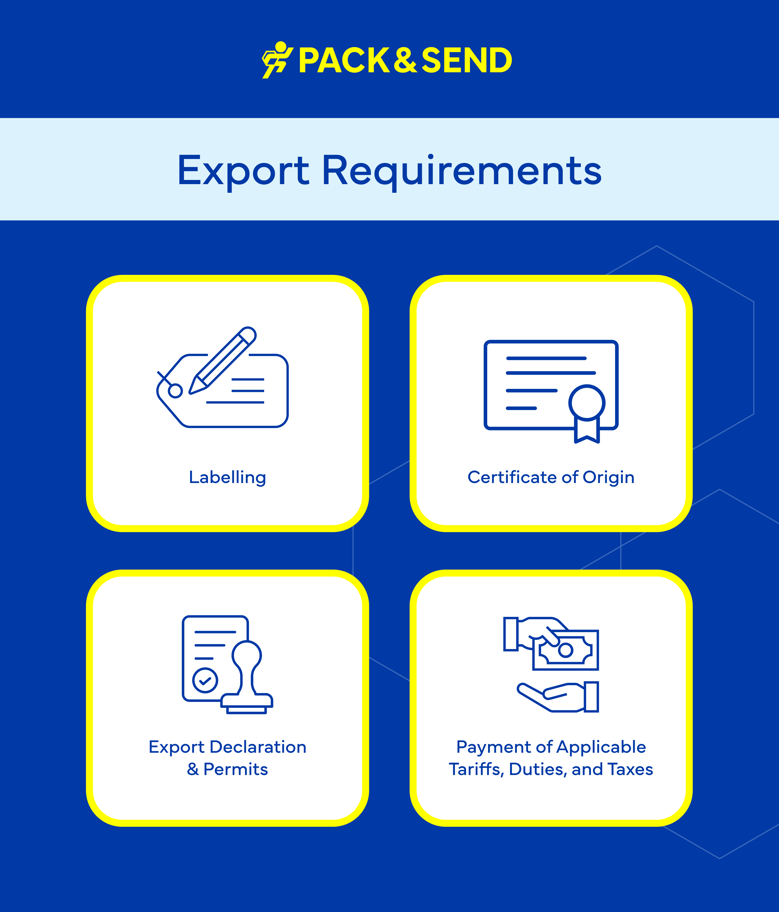
You need to be mindful of the following requirements before exporting goods from Australia. Some of these are necessary to complete the customs clearance process in Australia, while others will help the importer comply with customs requirements in their country.
Labelling
There are still no mandatory labelling requirements for exports under ABF, but exporters must avoid false or misleading trade descriptions. Additionally:
-
Labelling must comply with importing country’s standards
-
Consider adding accurate HS Codes and commodity descriptions for smoother foreign customs clearance
Certificate of Origin
You will need a Certificate of Origin if you are exporting to a country which has a Free Trade Agreement with Australia or if the importer requires this document for customs clearance in their country. You can use the DAFT Free Trade Agreement Portal to check the type of Certificate of Origin you will need for different countries and the process to acquire it.
Export Declaration & Permits
You need an export declaration and necessary permits for the customs clearance process. This declaration initiates the export process for customs clearance in Australia. We will discuss export declarations and permits in detail in the following section.
Do You Still Need to Pay Duties or Taxes on Exports?
In general, most exports are duty-free in Australia. However, the following may apply:
-
Export permit fees (if controlled goods)
-
Departmental processing fees (e.g. from DAFF or ABF for inspections)
-
Excise duty (if domestic goods such as fuel or alcohol are exported without proper licensing)
Note: The Integrated Cargo System (ICS) calculates payable amounts automatically once you declare goods.
How Do You File an Export Declaration?
An export declaration can be filed by an individual, organisation, or customs clearance company. It is a statement that provides information about the exported goods to the ABF. You need to submit this declaration to the ABF before your export the goods.
You can submit an export declaration through Integrated Cargo Systems (ICS) or at one of the ABF counters using export declaration forms (B957 and B957A). The export declaration can be submitted 6 months before the date of export. You can also submit an export declaration if you are importing goods from Australia.
2026 Update:
-
ICS is now mandatory for high-volume exporters or those using freight forwarders
-
Manual submissions are still permitted for small-scale exporters or when ICS is unavailable
Exporters can lodge declarations up to 6 months before the planned export date.
Export Declaration Forms
You do not need export declaration forms if you are filing for export customs clearance through ICS. These forms are only required if you are filing an export declaration through an ABF counter.
Export Declaration B957 Form
This form is mandatory for all export declarations. It requires you to provide details regarding the consignment, mode of transport, the exporter, the importer, transport schedule, and the goods.
Export Declaration B957A Form
You only need to file this form if your goods require an export permit or if the goods are minerals that require an assay. In such cases, you need to submit this form alongside the B957 form.
Submitting Export Declaration
You need to take a completed export declaration form to the ABF counter. But you should not sign the form until the officer at that counter asks for it. You will also need to present Evidence of Identity (EOI) documents or a client registration form (if a customs clearance company is filing on your behalf). Here is a list of acceptable EOI documents.
You also need to attach any relevant permits along with export declarations if necessary for the Australian customs clearance process. Check the list of prohibited items and their respective permits.
Once your export declaration is processed, the ABF will provide you with export entry advice. This document will contain one of the following permissions:
- Permission to export the goods.
- Permission to export the goods, subject to specific permission being obtained.
- Permission to export the goods, subject to security being provided as per Excise Act 1901, Section 16.
- Permission Denied (i.e. you cannot export the goods)
The ABF will contact you if the export declaration requires amendment. Alternatively, you can also file for an amendment in the export declaration using form B957.
On the other hand, if you want to withdraw an export declaration, you need to submit Export Declaration Withdrawal Notice Form B611 at an ABF counter. You can also apply for permission to move, alter or interfere with exported goods before they leave the country.
A Checklist of Best Practices for Export Customs Clearance
Here is an easy-to-remember checklist to help you complete the AU customs clearance process:
- Check the list of prohibited items to see whether or not you can export certain goods from Australia.
- Identify the HS Code for the goods you are exporting. Also, check the respective charges and permissions required to export those goods.
- Acquire the necessary permits and pay applicable charges before filing for import declaration.
- Submit the import declaration with the required documents attached.
- Acquire Export Entry Advice from ABF.
- Ensure that your consignment complies with the regulations of the importing country.
Conclusion
Failing customs clearance in Australia for either import or export can lead to penalties in form of fines, legal action, and imprisonment. That is why it is necessary to understand the laws and processes concerning Australian customs clearance. We hope that you will use insights from this article to ensure that your imported and exported goods are on the right side of the law.
If you want to ease your burden for legal processes and transportation, PACK&SEND can help you with international shipping and customs. Feel free to get in touch with us.
FAQs
What does customs clearance mean?
Customs clearance means that the government of a country is checking the imported or exported goods to see if they comply with the laws and regulations of the country. The goods can enter or leave a country only after completing the customs clearance process.
How much does customs clearance cost in Australia?
Customs clearance costs in Australia are generally 5% of the value of goods and an additional 10% GST. Although this cost can change depending on the type of goods and country of import or export. Check the customs clearance fees section in this article to find out the applicable costs.
How long do parcels take to clear customs in Australia?
International parcels usually take 24 to 48 hours to clear customs in Australia if the goods comply with import laws and the importer has submitted the necessary documents, fees, and taxes. Although customs clearance can take longer for certain types of goods that require biosecurity checks or quarantine measures before entering the country.
Does customs check every package in Australia?
Yes, customs check every package in Australia that arrive through a seaport or an airport. Any package that does not comply with Australian laws can be seized by customs.
How do I know if customs has my package in Australia?
You can use the Australia Post tracking page to check the status of your package in Australia. The Australian Border Forces hand over packages to Australian Post after completing the customs clearance process.
How long does customs clearance take in Australia?
Most shipments clear within 1 to 3 business days, but delays may occur due to inspections, missing documents, or unpaid duties.
What is import customs clearance?
It involves ABF reviewing your shipment, verifying documents, assessing duties or GST, and releasing goods into Australia.
What does "import customs clearance started" mean?
It means ABF has begun reviewing your declaration and documents for the imported shipment.
What does "customs clearance completed" mean?
It means your goods have cleared border checks and are approved for delivery or release from the warehouse.
What happens after customs clearance is completed?
Goods are released to the freight forwarder or consignee for final delivery, depending on the Incoterms used.
How long from customs clearance to delivery?
Delivery usually happens within 1 to 2 days after clearance, depending on your courier or freight partner.
What does "customs clearance delay" mean?
It indicates a hold due to inspections, incorrect documentation, unpaid duties, or regulatory red flags.
What does "abnormal customs clearance" mean?
This refers to irregularities such as missing permits, valuation disputes, or misdeclared goods that trigger extra review.
What is export customs clearance?
It’s the process of reporting goods to ABF before shipping them out of Australia, including declarations and any required permits.
What does "export customs clearance complete" mean?
It means your export declaration has been accepted and your goods are approved to leave the country.
What is a clearance fee for customs?
A clearance fee is the charge for processing import or export declarations. It can include entry processing fees, biosecurity charges, and broker service fees.
What is T1 customs clearance?
T1 refers to a transit document used in the European Union to move goods under customs control between EU countries. It is not applicable in Australia.
Does DAP include customs clearance?
No. Under the Delivered at Place (DAP) Incoterm, the buyer is responsible for import customs clearance and any duties or taxes.