
The eCommerce industry in Australia has significantly grown in recent years, with the global market size forecasted to reach $73.4 trillion by 2030. To cater to this growing global demand, you must also establish a strong supply chain and logistics strategy.
Whether you are delivering goods across the state or importing products from another country, there are several duties, taxes, and costs to consider in the process. However, before we delve deeper into the specific tariffs and duties, let us first understand what the primary Australian import duties and tariffs.
What Do Duties and Tariffs Mean?
The charges imposed by a government based on imported goods are known as duties and tariffs. These Australian import duties and tariffs are usually implemented as a percentage of the customs value of your goods or shipments.
In Australian logistics, the word “tariff” refers to the scheduled rate associated with a specific HS (Harmonised System) code, whereas “customs duty” refers to the actual charges assigned to cargo, based on the tariffs.
To be clearer, tariffs are applicable only for goods being moved across borders, and are vastly different from fuel surcharges, GST, or other costs associated with the process.
Australia’s import taxes may seem like a separate cost to consider in the process. However, it is simply a broader term that includes customs duties and any other indirect taxes like LCT, GST, and WET, among other excise duties.
Together, these duties and tariffs shape the landed costs and influence the pricing, profit margins, and competitiveness associated with a product in the Australian market.
7 Key Types of Duties and Taxes in Australia
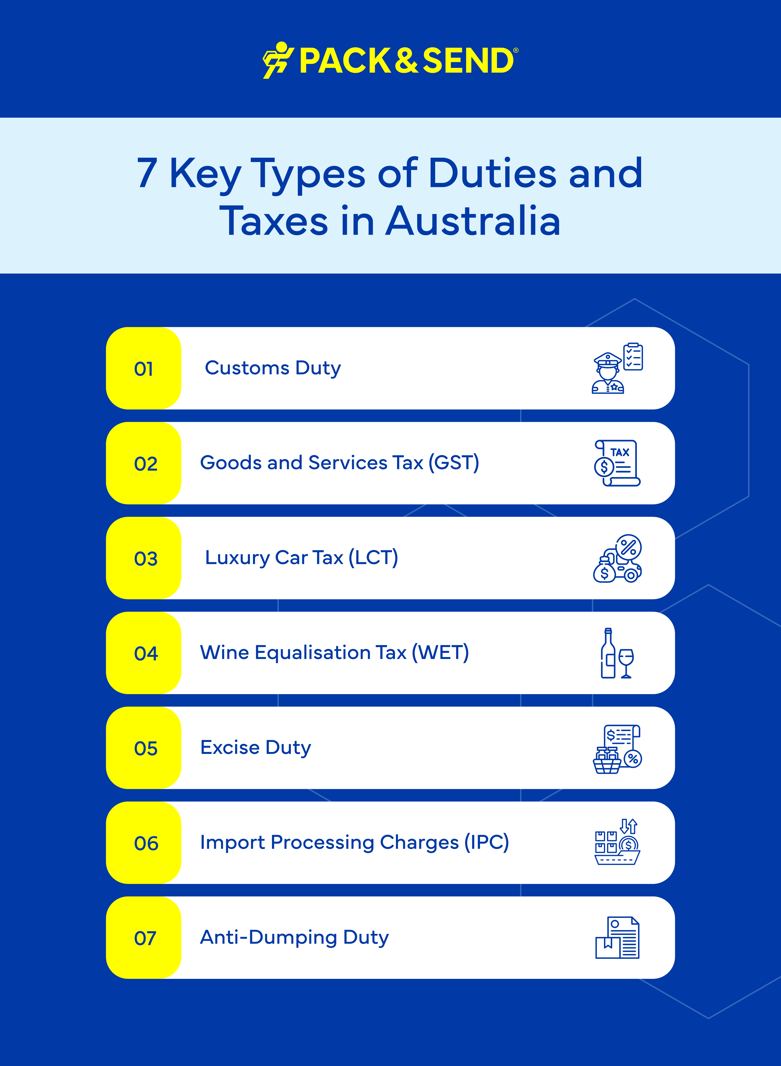
Australia applies a wide range of distinct charges on imports, including broad and specific costs that govern the process.
Understanding the duties and taxes that apply to your goods or products can be the foundation of a strong and compliant importing strategy.
Broadly speaking, there are two primary types of duties and taxes that all Australian imported shipments are subject to the goods and services tax (GST) and customs duties. Let us first explore these two charges in detail:
1. Customs Duty
In Australia, customs duties are levied on products that are classified under the broader umbrella term of the Working Tariff.
Customs duties are levied by government agencies to determine how freely a particular product can circulate or be moved within the country. Most duties are also shaped by international trade negotiations and are subject to change.
Customs duties are calculated or determined based on a specific product’s import value and the importing laws in Australia.
Typically, a flat customs duty rate of 5% is applicable on all products of value above AUD 1,000 if they are not eligible for any preferential treatment.
The percentage of customs duty applied to specific products or categories largely depends on how much the country needs them. Typically, customs duties on products can range from 0% all the way up to 30-40%.
For example, if the United States (US) produces a lot of corn, the government may opt to implement a high percentage of duty on corn imports from other countries as an attempt to curb outgoing costs.
Higher customs duties are levied on products to motivate consumers and companies to source them from local manufacturers rather than importing them.
On the other hand, lower customs duties mean that consumers can get access to the best products at competitive prices across the globe.
2. Goods and Services Tax (GST)
Aside from the customs duties applicable, Australia also levies 10% GST on most imported goods. The GST applicable to goods is calculated based on the Value of Taxable Importation, or the VoTI associated with them.
The VoTI for any product usually includes customs value, freight, insurance, and import duty rates in Australia.
The Australian Border Force (ABF) collects GST during customs clearance for every shipment that is valued over AUD 1,000.
For shipments that are valued lower, GST is generally accounted for in the price consumers pay to purchase the product during checkout under the Low Value Imported Goods (LVIG) policies and rules.
GST can be charged and enforced by sellers or marketplaces that are registered in Australia.
However, goods like basic food items, medical products, or educational materials are usually GST-free, but importing goods like alcohol or tobacco may attract additional excise duties and a higher tax percentage in Australia.
However, when you are importing goods from other countries to Australia, the rules applicable may look different.
For example, if you are importing goods from Malaysia, a country that does not enforce GST, it may still be applicable when being imported into Australia, where the buyer or importer is registered.
Aside from these charges, you must also learn about the following tariffs, duties, and taxes to get more clarity on the overall cost of importing goods into Australia.
3. Luxury Car Tax (LCT)
If you are importing a luxury car into Australia, you must know about Luxury Car Tax or LCT, which refers to a tax imposed on luxury vehicles over a certain threshold. Calculated based on the value of your luxury vehicle, the tax rate thresholds differ based on the fuel efficiency and features.
In 2025-2026, Australia levies a 33% tax on most cars costing over $80,567 and fuel-efficient vehicles costing over $91,387.
The application of LCT on luxury vehicles can impact their landed costs and will be added to GST and customs duties. Importers who inaccurately calculate LCT can risk underpayments and liabilities based on audits.
Wherever commercially feasible, you must structure your pricing and product selection to lower the LCT exposure.
4. Wine Equalisation Tax (WET)
WET is a specific tax levied on wine and wine-based products, currently applied at 29% of their overall value.
WET is not only specific to Australian imports, but also applicable to wine that moves through the international logistics and supply chain within the country, and is designed to tax wine at a single point in the process, usually at the wholesale level.
In the case of imported wine, the WET applies in addition to the customs duties and tariffs, and becomes a significant part of your total tax calculation. You must map your supply chain properly to understand the point at which WET is triggered and the parties responsible for it.
5. Excise Duty
Excise duty refers to the import tax in Australia levied on specific goods like fuel, tobacco, or alcohol when they are transported within the country or imported into Australia. Excisable goods, when imported, may attract customs duty based on the local excise rate.
These goods are also applicable once they enter an excise-licensed warehouse.
The excise rates applicable to goods can be quite substantial and are usually volume-based, contributing significantly to the overall landed costs for affected categories.
For example, the excise duty imposed on beer is based on its alcoholic strength, its size, and design. If the alcohol volume exceeds 3.5% and is stored in containers of over 48 litres, you can incur excise rates of over 43.39%.
You must confirm product classifications with technical specifications to ensure that the right excise duty or WET is implemented on your imports.
6. Import Processing Charges (IPC)
Import Processing Charges (IPC), enforced by the Australian Border Force (ABF), refer to the fees for processing necessary import declarations and other related documentation.
The IPCs can vary by consignment value, lodgement method, and cargo type (air/sea), and they usually apply to most commercial imports over certain thresholds.
For example, the Australian Border Force assesses the value of your consignment to publish a schedule setting fixed IPC amounts for specific value bands, and whether the lodgment mode is electronic or on paper.
You must note that IPCs are applied on a per-shipment basis, amounting to a significant chunk of your landed cost calculations, especially when dealing with large shipment volumes.
7. Anti-Dumping Duty
Certain goods may be subsidised or dumped (sold at less than their actual value) in their country of origin.
When such goods enter the Australian industry and are likely to disrupt the demand and local revenue, the government imposes anti-dumping and countervailing duties.
Such duties are usually product-specific and country-specific, and imposed after a thorough investigation of goods by authorities.
Anti-dumping duties can also be calculated as ad valorem (percentage of customs value) and can dramatically increase the overall landed costs of the affected import to Australia.
Always keep a check on the most updated anti-dumping measures against your HS code and the origin country before sourcing to high-risk sectors.
Understanding Free Trade Agreements & Concessions
Australia has entered into a wide range of free trade agreements (FTAs) with individual countries and regions.
Aimed at reducing or removing the customs duties and improving market access, these agreements set tariff rates preferentially for qualifying goods, often phasing down to zero over time.
Australia has entered into FTAs with several countries, like China, Japan, the United States, Korea, and India, among others. For example, agreements like AUSFTA have removed or adjusted duties on a high percentage of tariff lines for traded goods. Such agreements can also mention specific concessional tariffs for specific types of goods and imports.
Concessional tariffs can also exist under domestic law to allow special, reduced rates for specific medical or educational goods. Use official FTA portals and tariff lookup tools to help you identify HS codes and origin combinations, and qualify for lower tariff rates.
How are Duties and Tariffs Calculated?
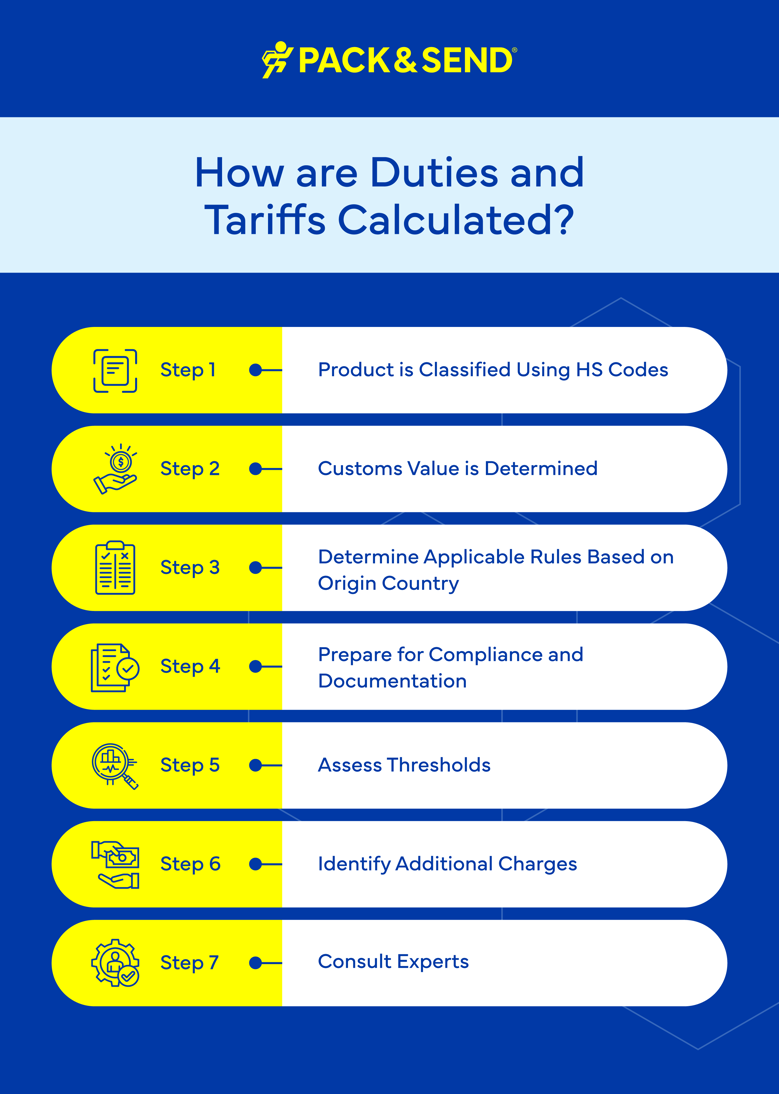
The calculation of Australia's duties and taxes when importing goods utilises a structured process, factoring in three primary parameters: classification (HS code), valuation (customs value), and origin (standard vs preferential rate).
Each step in the calculation process introduces crucial challenges, such as overpayment, underpayment, or delays, if any aspect of the process is handled incorrectly.
Step 1: Product is Classified Using HS Codes
When a product is imported into Australia, you must assign an HS code, typically using a six-digit global base, with additional digits for national subheadings.
The HS code associated with your shipment or goods will determine the applicable duty rate and whether additional permits or regulatory controls are required.
For example, when you are importing different kinds of consumer electronics, the commercial descriptions across the products might be similar, but the codes and tariff treatments for each product will be distinct.
Misclassification of goods is a major leading cause for customs disputes and triggers back-dated reassessments and disrupted supply chains.
You must build an internal HS classification database with justifications and technical specifications.
Involve product engineers or suppliers to confirm the functions, materials, and composition, as they can play important roles in assigning the right codes to products.
Step 2: Customs Value is Determined
Customs value (CVAL) in Australia is crucial for determining and calculating the duties and parts of the GST base.
The customs value of a product is generally aligned with the transaction value of the goods, with necessary adjustments based on validation rules specified in the Customs Act and related guidelines.
When calculating customs duties, certain specific charges such as assists or royalties can be added, and buying commissions may be excluded.
Getting the valuation of your product shipment wrong can impact and disrupt your downstream calculations, and affect the process more than a misapplied small duty rate.
You can map specific invoice items and side agreements that may need to be included in the customs value.
Step 3: Determine Applicable Rules Based on Origin Country
Once you have determined the HS code and customs value, another key factor to consider is origin, as it decides the applicability of standard or preferential rates.
You must keep in mind that the origin and the country of shipment may not be the same, as it depends on the location for the subsequent transformation of goods.
You can easily secure lower or zero duties under a free trade agreement. However, you must have access to original documentation and show that your goods comply with the processing rules specified in the FTA.
Failing to comply with the origin requirements can result in penalties and clawbacks.
Maintain the supplier origin declarations and production records for the retention period specified by the Australian laws and relevant free trade agreements.
Step 4: Prepare for Compliance and Documentation
When managing imports, Australia requires very accurate and complete documentation for customs clearance, including documents like commercial invoices, packing lists, licenses or permits, and import declarations.
Any missing or inconsistent data can lead to extra storage costs, cause delays, or even lead to refusal of entry.
Customs brokers can often handle and manage the technical aspects of declarations. However, importers remain responsible and liable in case of any data inaccuracies.
To reduce friction in post-clearance audits or disputes, following strong documentation practices is more important than classification and valuation.
Standardise invoice templates and packing lists to ensure they contain necessary information like origin country, Incoterms, production descriptions, and HS codes.
Step 5: Assess Thresholds
Australia has set specific value thresholds that impact how taxes and duties are applied to imported consignments and shipments. For instance, the LCT or luxury car tax applies to cars valued over the set threshold of $80,000 and $91,000, depending on their fuel efficiency.
The value thresholds for low-value shipments work differently compared to standard commercial shipments. Additionally, many special rules apply to GST for low-value goods sold online to Australian consumers.
If your shipment crosses key value thresholds, there are many additional formalities and charges, such as IPC. Being aware of the thresholds can help you plan shipment consolidation, retail pricing, and eCommerce logistics.
Your eCommerce logistics strategy must be designed with your value thresholds in mind, and ensure that your Australian import tax obligations are managed correctly between buyer and seller.
Step 6: Identify Additional Charges
Beyond the core duties and taxes applicable to the standard import process, importers often deal with additional costs like brokerage charges, cargo screening, storage fees, and quarantine inspection fees.
While none of these charges or costs are classified as tariffs or duties, they add substantially to the total landed cost and rival the government charges associated with low-margin goods.
Request a detailed breakdown of your landed costs from your customs brokers or freight forwarders, itemising the government vs. third-party charges.
Step 7: Consult Experts
Importers operating at a smaller level can start by calculating the duty and taxes using online Australian import tax calculators and carrier estimates. However, as your volumes, value, and product diversity grow, involving a customs broker or trade compliance specialist is no longer optional.
For strategic or large categories, companies can achieve advance rulings or written advice on the valuation, classification, or origin to gain certainty and minimise audit risks. You must establish SLAs with brokers that include classification review, regular tax/duty reports, and FTA optimisation, instead of basic clearance.
5 Common Challenges and Solutions Associated With Duties and Tariffs in Australia
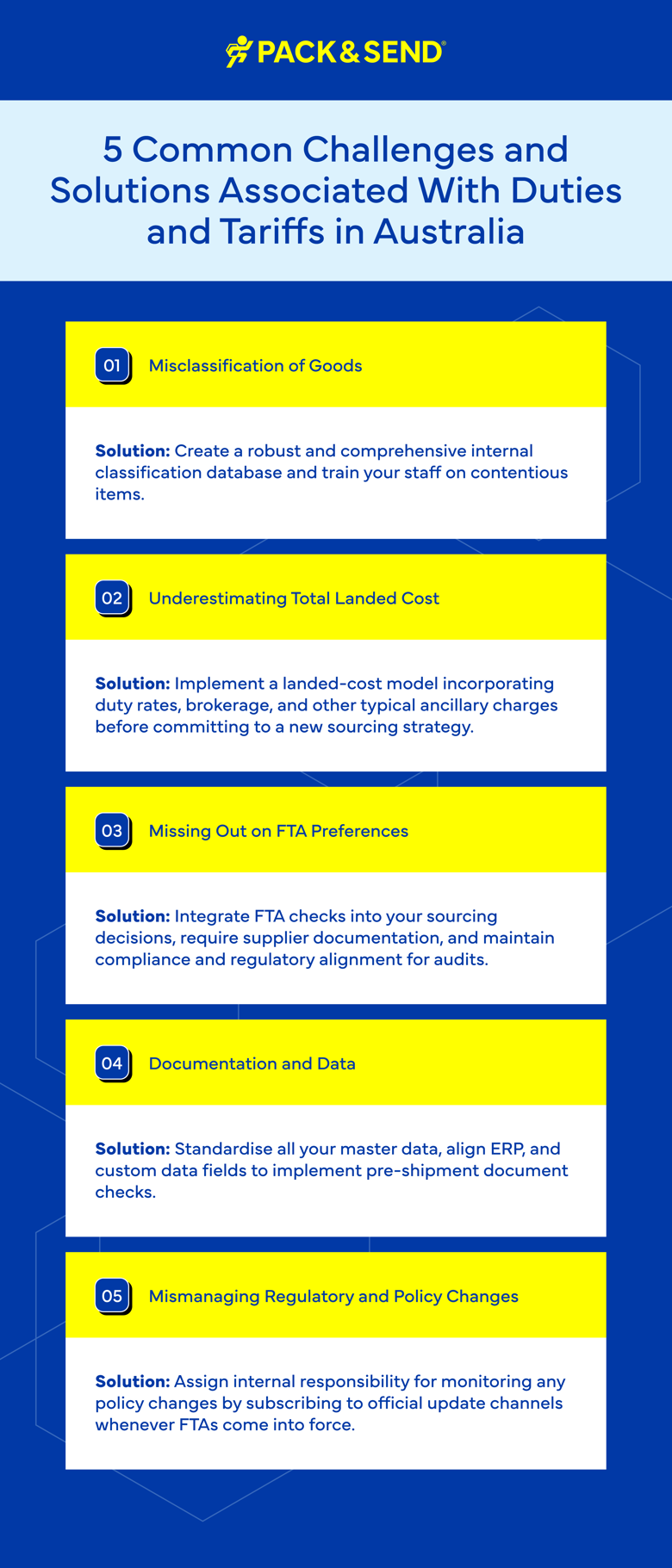
Australian importers encounter recurring duty and tariff-related challenges and complexities.
However, most of these challenges can be mitigated with the help of better data, processing, and partnerships.
Let us now explore the primary challenges related to duties and tariffs and their respective solutions:
1. Misclassification of Goods
Misclassifying your goods can often lead to underpayment or overpayment of duties, whether in terms of adding incorrect codes or categories.
Such misclassifications can also result in penalties and back payments wherever underpayment occurs.
Solution: Create a robust and comprehensive internal classification database and train your staff on contentious items.
2. Underestimating Total Landed Cost
A common mistake most shippers or retailers make is focusing too much or exclusively on the supplier unit price.
When you ignore other duties, taxes, IPC, and special fees associated with your shipment, it can often lead to margin erosion.
Solution: Implement a landed-cost model incorporating duty rates, brokerage, and other typical ancillary charges before committing to a new sourcing strategy.
3. Missing Out on FTA Preferences
Some importers in Australia end up paying full MFN (Most-Favoured-Nation) duty even if they are eligible for preferential rates because of free trade agreements.
Whether it is caused by a lack of original paperwork or knowledge, wrong FTA preferences can elevate costs.
Solution: Integrate FTA checks into your sourcing decisions, require supplier documentation, and maintain compliance and regulatory alignment for audits.
4. Documentation and Data Inconsistencies
Having significant differences in the information contained across invoice descriptions, HS codes, and declaration data can be detrimental.
Even with those inconsistencies in data, you could delay clearance or trigger extra scrutiny.
Solution: Standardise all your master data, align ERP, and custom data fields to implement pre-shipment document checks.
5. Mismanaging Regulatory and Policy Changes
When you are in an evolving and growing industry, you may often deal with changing regulations and policies that are difficult to implement.
Since tariff schedules, import rules, and FTAs evolve very regularly, mismanagement of these policies can affect the duty rates and conditions.
Solution: Assign internal responsibility for monitoring any policy changes by subscribing to official update channels whenever FTAs come into force.
Concluding Remarks
Whether you are looking to increase sales or imports into Australia, you must know about the various taxes, duties, and tariffs to consider in the process.
International shipping already involves longer turnaround times and expensive decisions, which can pose challenges for retailers.
By understanding the international shipping and trade processes and the subsequent costs associated with them, you can enhance your operational efficiency and planning.
Get a quote from the PACK & SEND website to get assistance with your documentation and budgeting for international shipping.
Frequently Asked Questions (FAQs)
1. What is Customs Duty?
Customs duty refers to taxes imposed on imported goods that are entering Australia, calculated based on the applicable tariff rate and customs value under the Australian tariff schedule. Customs duty serves revenue and trade-policy purposes, and may be reduced or eliminated where FTAs are involved.
2. What's the difference between import taxes and customs duties?
Customs duties are specific charges associated with HS codes and tariff rates of a product. On the other hand, the term “import taxes” includes multiple costs and taxes such as LCT, GST, WET, IPC, and other border-related charges.
3. What are the different types of import taxes in Australia?
Some of the key import-related taxes and charges in Australia include GST, customs duty, LCT, WET, excise duty, and other equivalent charges on excisable goods. Aside from these costs, you may also incur additional regulatory or service fees associated with cargo screening or quarantine inspections.
4. How is customs value calculated in Australia?
Customs value in Australia is based on the transaction value of the goods and can be adjusted based on the customs valuation rules, according to the Customs Act. Aside from this, you must also consider additional elements like royalties, assists, and handling costs when calculating the overall import charges and taxes.